- What reaches them
- A rejection, or structured feedback naming a shortfall in an area the candidate has shipped work in.
- What it means from there
- The work exists. What is not visible from here is which surface was opened and what it showed.
- What happens next
- Restructures what is submitted: the relevant work pinned, the commits linked directly rather than the account, the ownership stated in the CV line rather than left to be discovered.
Portfolio / Work Artifact Misinterpretation
The surface a screener opens does not show the candidate's architecture work, which sits in a non-standard repository layout or in contributions under another organisation.
Mechanismmech.portfolio_work_artifact_misinterpretationCandidate actionActor: candidateNature: noiseVisibility: inferableAgency zone: candidateEvidence: supported
📐 On the canonical path
Assessed on the work, against a rubric that is shared — One timeboxed exercise that resembles the job. The candidate is given the criteria before starting, the timebox is enforced against the evaluator as well, and the same rubric scores everyone.
This entry is one of the ways that commitment stops being kept.
What it looks like
Composite excerpts, written to be typical rather than copied. No particular message, company or person is quoted here.
Screener note: mostly forks, little original work, no evidence of architecture ownership.
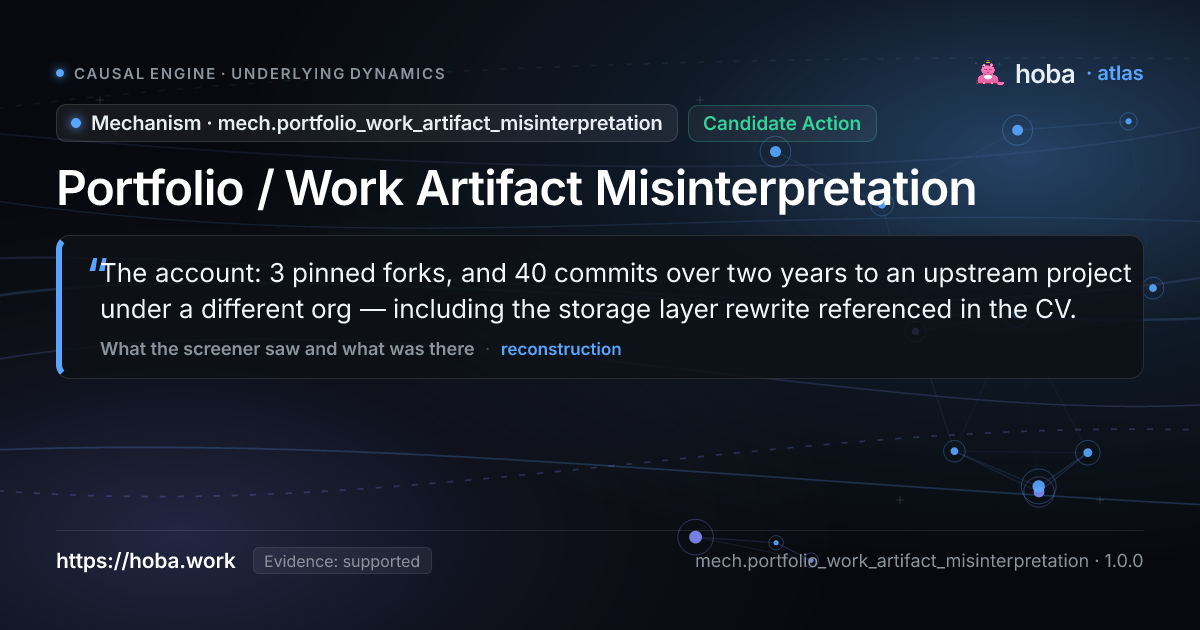
The account: 3 pinned forks, and 40 commits over two years to an upstream project under a different org — including the storage layer rewrite referenced in the CV.
What to notice: The work exists and the surface that was checked does not show it. This is a discovery failure, and it is one of the few the candidate can fix directly.
Barriers where this mechanism operates
Observations this mechanism emits
- obs.feedback_naming_as_absent_something_the_submitted_work_containsFeedback naming as absent something the submitted work containsFidelity: directRead by the candidate at: Screening
- obs.generic_closer_alignment_rejection_templateGeneric "closer alignment" rejection templateFidelity: euphemismRead by the candidate at: Screening
- obs.explicit_feedback_citing_skill_depth_shortfallExplicit feedback citing skill-depth shortfallFidelity: distortionRead by the candidate at: Technical
What this does NOT establish
- Misinterpreted architecture can be corrected through structured documentation.
Causal relations
Interventions targeting this mechanism
- int.candidate_work_index_submitted_with_the_applicationCandidate Work Index Submitted With the ApplicationSubmit a one-page index naming each work artefact, the part of it that is the candidate's and the direct path to it, and open that index in the first minutes of the live screen.
- int.screening_note_bound_to_observations_and_disposition_codesScreening Note Bound to Observations and Disposition CodesRestrict the screening note to the requirement, what the record shows and the surface opened, and close it with a fixed disposition code — including a referral to levelling for profiles above the graded band.
Reached without being linked
The relations above are one step. This is what the entry reaches only by walking through them — the shape of it, since the list runs long in a registry this cross-referenced.
- 8
- Barrier8
From each side
The same entry from inside each position that meets it: what reaches them, what it means from there, and what happens next given what they control.
- What reaches them
- A link and the minutes available for it, against an inbound volume larger than the week's screening capacity.
- What it means from there
- The surface that opens is the profile. A page of forks reads as little original work, because what is not on it cannot be told apart from what does not exist.
- What happens next
- Records the note from what the page showed and moves to the next application. That note travels forward as the evidence about the candidate's work.
- What reaches them
- A shortlist and the screening notes attached to it, not the repositories themselves.
- What it means from there
- Architecture ownership was checked and not evidenced, which is what the note in front of them says.
- What happens next
- Spends the panel's time on the shortlist as delivered. Reopening a screened-out profile costs review hours the team is already short of.
ATS vendorNot visible from here
From this position the entry is not visible. That is not a gap in the atlas — it is the finding: the decision is made where nobody in this position can see it.
ClientNot visible from here
From this position the entry is not visible. That is not a gap in the atlas — it is the finding: the decision is made where nobody in this position can see it.
Employer policyNot visible from here
From this position the entry is not visible. That is not a gap in the atlas — it is the finding: the decision is made where nobody in this position can see it.
Public policy and industry standardsNot visible from here
From this position the entry is not visible. That is not a gap in the atlas — it is the finding: the decision is made where nobody in this position can see it.