- What reaches them
- Two verdicts from the same week: one round rating architectural depth highly, another finding depth insufficient for the level, and one negative decision under them.
- What it means from there
- The rounds asked different questions and both reported the answer as depth. Which of the two the decision rests on is not stated.
- What happens next
- Asks for the consolidated rubric summary, and records what each round actually asked alongside what each concluded.
Conflicting feedback across different interviewers
Feedback from one round praises architectural depth while another round claims insufficient technical background.
Observation A-014 TechnicalTeam Evidence: supported Status: active
On the canonical path
Declined, with a reason that can be acted on — Not every candidate is hired, and a decline is not a deviation. What makes it part of this path is that it arrives, it names the stage it happened at and the criterion that decided it, and it says whether applying again is worth anything.
This entry is one of the ways that commitment stops being kept.
What it looks like
Composite excerpts, written to be typical rather than copied. No particular message, company or person is quoted here.
Subject: Consolidated feedback
Round 2 (systems): Strong architectural depth. Reasoned clearly about consistency trade-offs and failure modes. Recommend proceed.
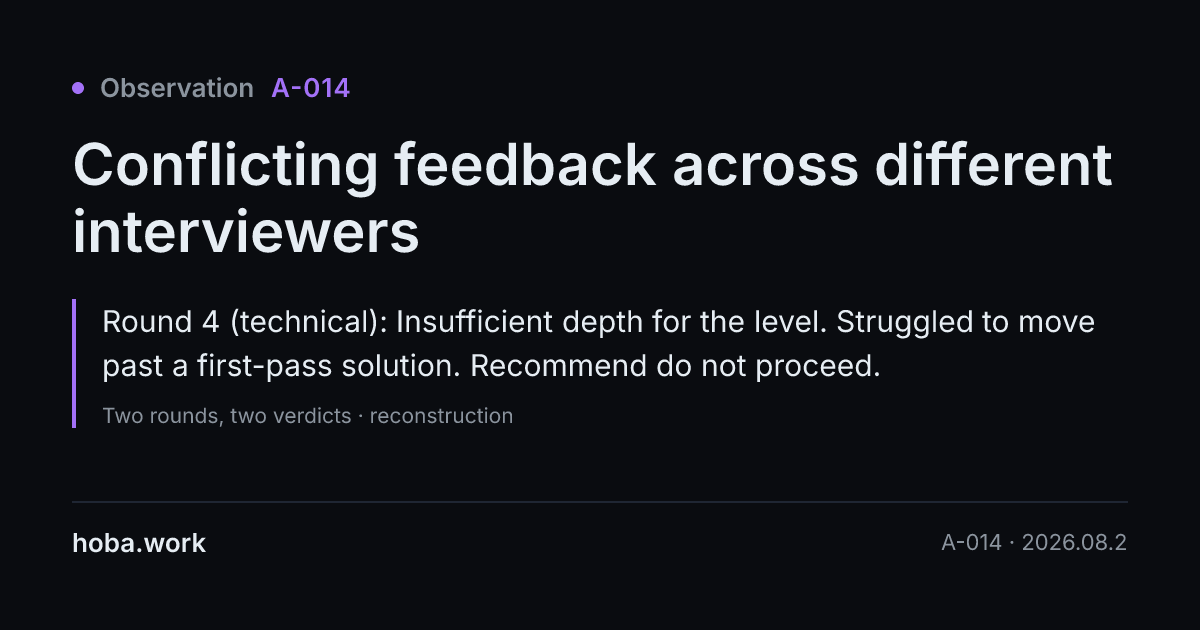
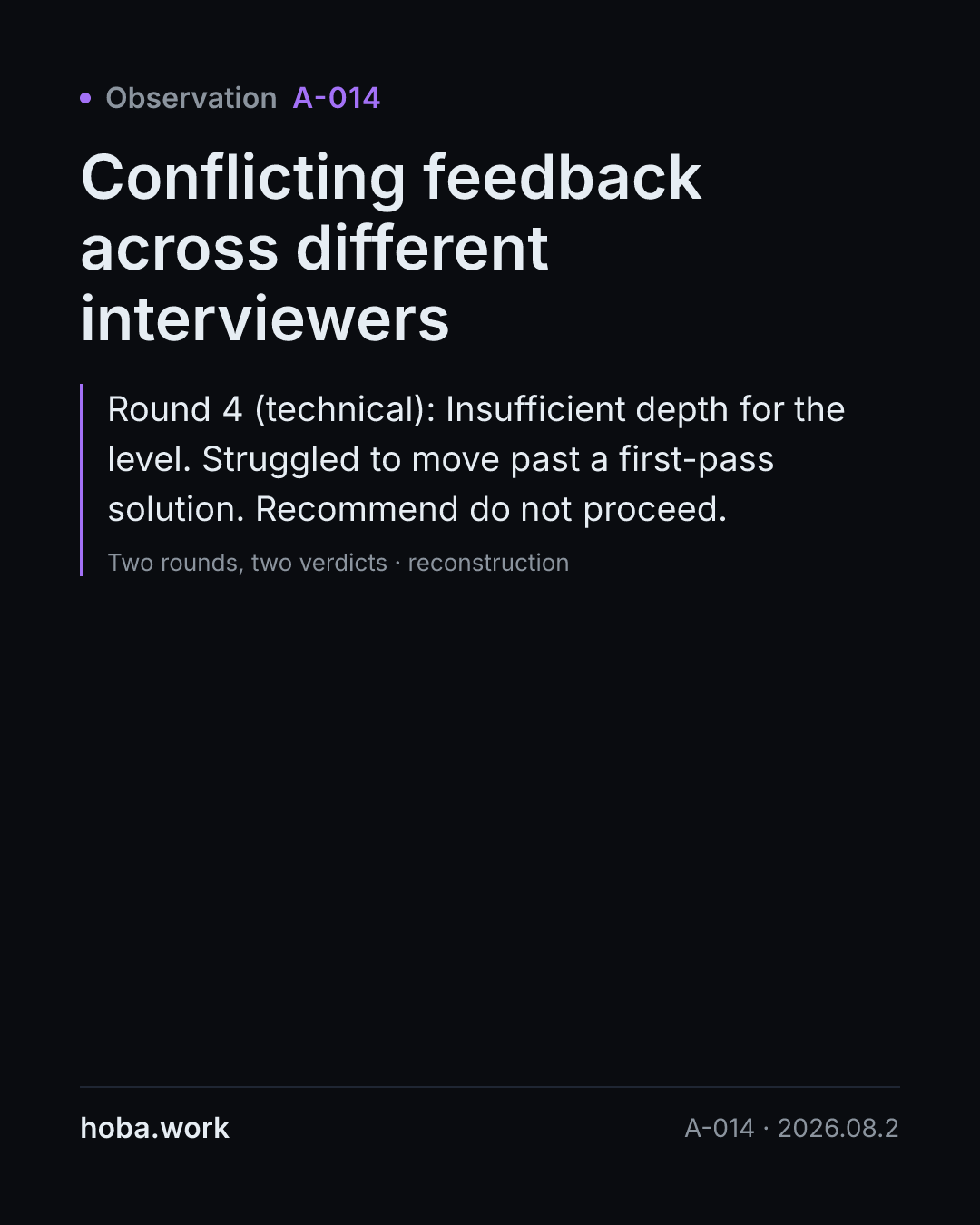
Round 4 (technical): Insufficient depth for the level. Struggled to move past a first-pass solution. Recommend do not proceed.
Final decision: do not proceed.
What to notice: Both notes are about the same person in the same week. At least one of them is measuring something other than the candidate.
- 08:30 Interviewer B Round 2 — Walk me through how you would keep two regions in sync when the link between them drops.
- 03:10 Interviewer D Round 4 — Here is a string parsing problem. You have twenty-five minutes.
What to notice: The rounds did not disagree about the candidate; they measured different things and reported both as depth.
How to read this observation
An observation is something a candidate received or lived through. It is a consequence of the mechanisms underneath, not proof that any one of them was at work.
Diagnostic probes
- Probe PROBE-A-014-1 Cost: low
Action: Request aggregated hiring rubric summary from talent partner.
Expected observation: Reveals whether team had misaligned internal evaluation criteria.
Compatible mechanisms (2)
Open the analysis walkthrough →- M-010 Hidden Evaluation Rubric or Undisclosed Priority intermediary The interview team grades candidate against specific undisclosed architectural dogmas, internal frameworks, or unwritten biases.
- M-022 Hiring Manager Consensus Impasse none The interview panel splits 50/50 without an executive tiebreaker, defaulting conservatively to a "no-hire" decision.
What this observation does NOT establish
- Does not prove bad faith; highlights lack of rubric calibration across the hiring committee.
From each side
The same entry from inside each position that meets it: what reaches them, what it means from there, and what happens next given what they control.
- What reaches them
- Two written notes on the same candidate from rounds they did not sit in, each using the word depth for a different exercise.
- What it means from there
- Those notes are the whole of what is available about those rounds; nothing in them separates a disagreement about the candidate from a difference between the two exercises.
- What happens next
- Sets who interviews and what each round asks, and closes the split with a decision rather than a re-run. A hire made over a recorded negative note carries their name if it goes wrong.
- What reaches them
- Two recommendations pointing opposite ways and a decision line under them. The scores behind each recommendation are not in the recruiter's view.
- What it means from there
- One reason has to be written to the candidate out of two notes that do not agree. Anything said beyond the recorded decision can be quoted back later.
- What happens next
- Sends the outcome in wording that stays inside what was written down, and moves the requisition on. Reopening a recorded decision sits with the hiring manager, not the recruiter.
ATS vendorNot visible from here
From this position the entry is not visible. That is not a gap in the atlas — it is the finding: the decision is made where nobody in this position can see it.
Employer policyNot visible from here
From this position the entry is not visible. That is not a gap in the atlas — it is the finding: the decision is made where nobody in this position can see it.
Public policy and industry standardsNot visible from here
From this position the entry is not visible. That is not a gap in the atlas — it is the finding: the decision is made where nobody in this position can see it.