- What reaches them
- A rejection naming experience above the band scoped for the role, and a retention concern raised at the screen, before any technical round.
- What it means from there
- The stated ground is fit with a band rather than the work shown. The message does not say whether a requisition at another level exists.
- What happens next
- Asks whether anything is open at a higher level, and records the stated reason and the date it was given.
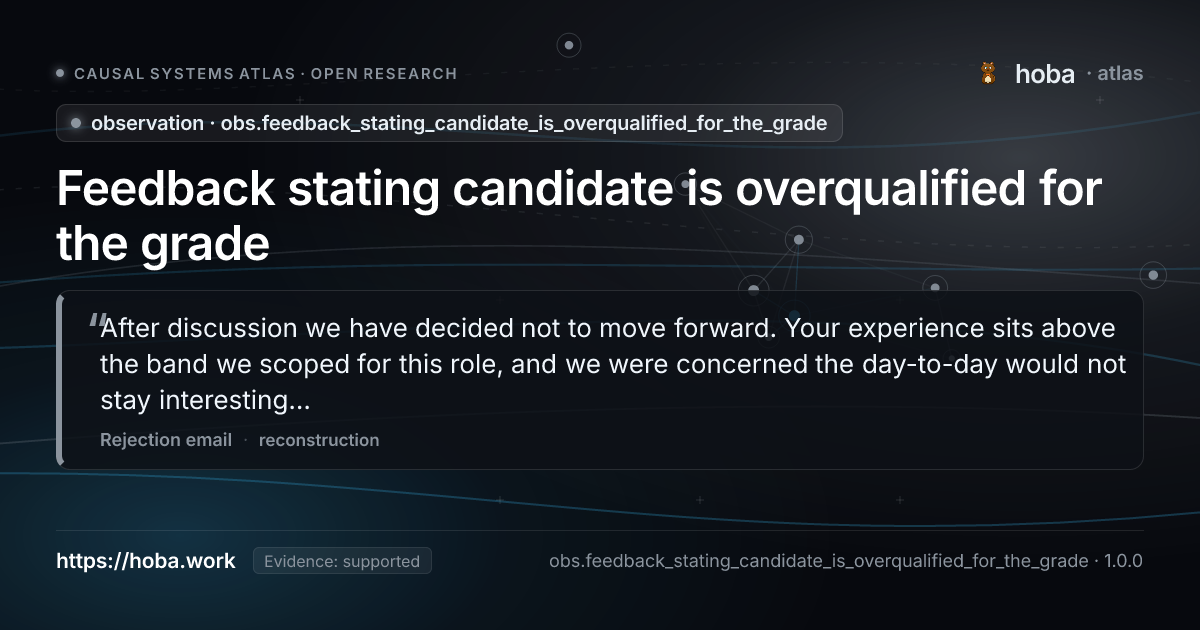
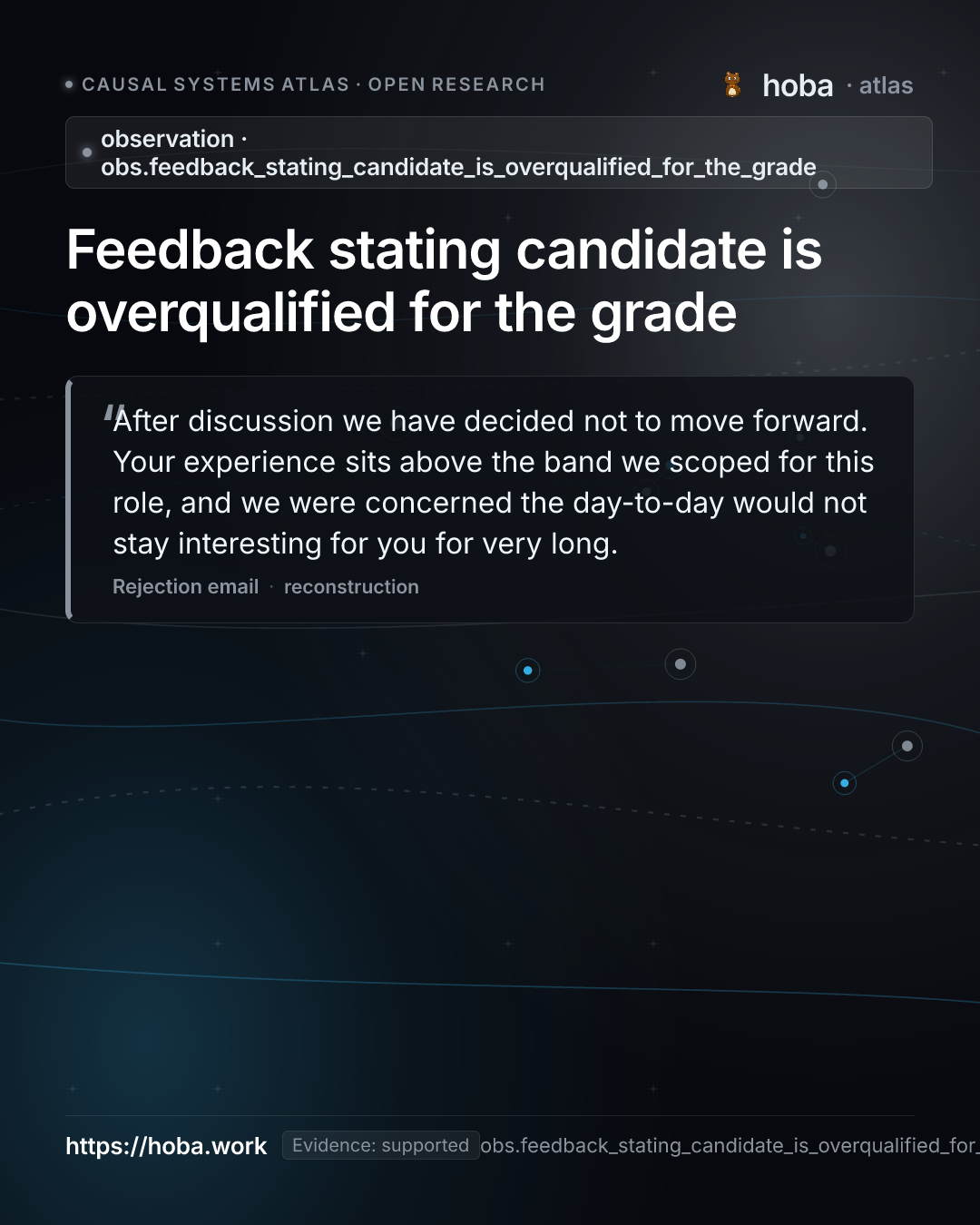
Feedback stating candidate is overqualified for the grade
Candidate is rejected on the grounds that their experience, seniority, or previous scope sits above the band the role was opened at.
Observationobs.feedback_stating_candidate_is_overqualified_for_the_gradeRecruiterScreeningTeamEvidence: supportedStatus: active
📐 On the canonical path
Declined, with a reason that can be acted on — Not every candidate is hired, and a decline is not a deviation. What makes it part of this path is that it arrives, it names the stage it happened at and the criterion that decided it, and it says whether applying again is worth anything.
This entry is one of the ways that commitment stops being kept.
What it looks like
Composite excerpts, written to be typical rather than copied. No particular message, company or person is quoted here.
Subject:Your application — Senior Backend Engineer
Thank you for the time you gave us over the past two weeks. The team enjoyed the conversation and rated your systems background highly.
After discussion we have decided not to move forward. Your experience sits above the band we scoped for this role, and we were concerned the day-to-day would not stay interesting for you for very long.
We would be glad to keep your profile on file and reach out when something at the right level opens up.
What to notice: The stated ground is fit with a band, not the quality of the work — and the risk named is retention, not capability.
- 14:02RecruiterYour last role was a team lead position, is that right?
- 14:09CandidateFormally, yes. In practice about two thirds of my week was hands-on.
- 14:21RecruiterGot it. I will be honest with you — my worry is that this role is a step down, and six months in you would be looking again.
- 14:33CandidateRight now I am optimising for depth rather than scope.
- 14:38RecruiterUnderstood. I will pass that on either way.
What to notice: The concern is raised before any technical assessment: the level question is being settled ahead of the skill question.
How to read this observation
An observation is something a candidate received or lived through. It is a consequence of the mechanisms underneath, not proof that any one of them was at work.
Diagnostic probes
- Probe PROBE-A-013-1Cost: low
Action: Ask whether the organisation has requisitions open at a higher band or at staff level, where the wider scope is part of the role.
Expected observation: Shows whether anything is open above this band.
Compatible mechanisms (2)
Open the analysis walkthrough →- mech.experience_age_grading_mismatchExperience-Age Grading MismatchnoneA candidate with 10+ years applies for a role graded at mid or senior, and the screening note records forecasts about boredom, short tenure and salary expectation.
- mech.unstated_compensation_band_discrepancyUnstated Compensation Band DiscrepancyintermediaryCandidate market rate exceeds budgeted compensation for the requisition, but salary band was never published or clarified early.
What this observation does NOT establish
- Does not imply the candidate is undesirable; what it names is a concern about retention and about a pay mismatch.
Appears in these contradiction patterns
Reached without being linked
The relations above are one step. This is what the entry reaches only by walking through them — the shape of it, since the list runs long in a registry this cross-referenced.
- 24
- Mechanism7Pattern3Loop2Intervention12
From each side
The same entry from inside each position that meets it: what reaches them, what it means from there, and what happens next given what they control.
- What reaches them
- A profile whose last title sits above the role, against a requisition opened at one band that the screen cannot move.
- What it means from there
- The level question is answerable now, and the same mismatch found at offer stage costs the search weeks. What the hiring manager will accept at this level is not written down anywhere the recruiter can read it.
- What happens next
- Raises the concern on the call and passes the answer on. Changing the band is not theirs to do; the wording of the rejection is.
- What reaches them
- A candidate who has previously held a wider scope than the role carries, assessed at the level the requisition was opened at.
- What it means from there
- A hire who leaves early is visible and attributed to the person who made it; a candidate declined on level leaves no record anyone reads later.
- What happens next
- Declines at this band, or asks for the level to be reconsidered, which means a different requisition funded elsewhere.
- What reaches them
- One requisition approved at one band, and a levelling grid that defines what sits above it. Individual candidates do not reach this layer.
- What it means from there
- One band per requisition is what keeps offers consistent and defensible across every hire. A person declined at the edge of the grid is not an event this layer records.
- What happens next
- Holds the requisition at the approved band. Opening one at a higher level is a separate funding decision on a quarterly cycle.
ATS vendorNot visible from here
From this position the entry is not visible. That is not a gap in the atlas — it is the finding: the decision is made where nobody in this position can see it.
ClientNot visible from here
From this position the entry is not visible. That is not a gap in the atlas — it is the finding: the decision is made where nobody in this position can see it.
Public policy and industry standardsNot visible from here
From this position the entry is not visible. That is not a gap in the atlas — it is the finding: the decision is made where nobody in this position can see it.