- What reaches them
- The same engineers' calendars carrying the sprint and the panel, and a requisition running past its target date. What the loop costs the people covering the open work is not in that view.
- What it means from there
- An interviewer who is free is the option that keeps the loop moving; the alternative is another week on the requisition. A cold read is still a round completed.
- What happens next
- Puts whoever has the slot on the panel and takes the write-up that comes back.
Interview Resource & Scheduling Saturation
Engineering interviewers are overwhelmed with sprint commitments, leading to calendar fragmentation, rush reviews, or dropped loops.
Mechanism M-012 Intermediary dependent Actor: hiring managerNature: noiseVisibility: inferableAgency zone: intermediaryEvidence: supported
On the canonical path
One panel, one question each, one decision rule — Every interviewer knows what they are measuring and that nobody else is measuring it. The rule that turns their scores into a decision is agreed before the first conversation, and no round is added after the process has started.
This entry is one of the ways that commitment stops being kept.
What made this ordinary
The record funding years · 2020–2021 — Two years in which the policy floor returned and venture funding roughly doubled its previous record. Headcount plans were set against committed capital rather than against bookings, and the terms of entry were set on the candidate's side.
What it looks like
Composite excerpts, written to be typical rather than copied. No particular message, company or person is quoted here.
- Wed 17:40 Engineering manager Can you take the panel Thursday? Nobody else on the team is free.
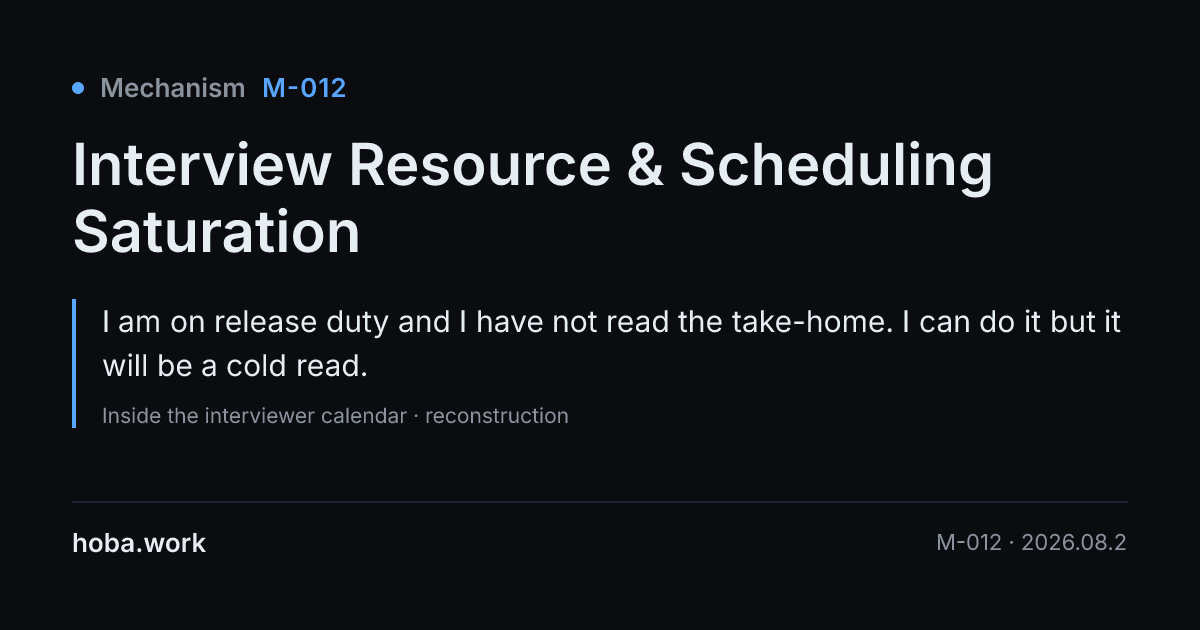
- Wed 17:52 Interviewer I am on release duty and I have not read the take-home. I can do it but it will be a cold read.
- Wed 17:55 Engineering manager Take it. We are already two weeks over on this req.
What to notice: The evaluation was compromised before it began, and nothing in the candidate could have changed that. This trace lives on the other side of the table.
Barriers where this mechanism operates
Observations this mechanism emits
What this does NOT establish
- Rescheduling is an operational issue and does not indicate negative evaluation.
Causal relations
From each side
The same entry from inside each position that meets it: what reaches them, what it means from there, and what happens next given what they control.
- What reaches them
- Rounds moved, gaps between them, and an interviewer opening the submitted work during the call.
- What it means from there
- The changes are visible only as their own calendar, where a scheduling constraint and a decline in interest look alike.
- What happens next
- Records each date and each change, asks what remains in the loop and by when, and keeps other processes live.
- What reaches them
- Panel slots that come back unfilled and dates that shift; the interviewers' other commitments sit on the calendars the recruiter is scheduling around.
- What it means from there
- A move is an operational fact with a date, and time-to-fill is measured on the total. There is nothing in it to report about the candidate's standing.
- What happens next
- Reissues the invitation with the new date and decides whether the candidate is told the loop has stalled.
ATS vendorNot visible from here
From this position the entry is not visible. That is not a gap in the atlas — it is the finding: the decision is made where nobody in this position can see it.
Employer policyNot visible from here
From this position the entry is not visible. That is not a gap in the atlas — it is the finding: the decision is made where nobody in this position can see it.
Public policy and industry standardsNot visible from here
From this position the entry is not visible. That is not a gap in the atlas — it is the finding: the decision is made where nobody in this position can see it.