- What reaches them
- A required field asking how long the domain takes, next to the requirement that names it.
- What it means from there
- The estimate is one the team already makes when it onboards internal transfers; writing it down is what stops the same domain being treated as unlearnable for outsiders.
- What happens next
- Enters the estimate, and either justifies the gate or accepts candidates who clear everything except the vertical.
Domain requirement carries a stated ramp time
A requisition that asks for experience in one named vertical must state how long the team believes that domain takes to learn; where the answer is weeks, the requirement is scored as a preference rather than a gate.
Interventionint.domain_requirement_carries_a_stated_ramp_timeActor: hiring managerScope: teamCost: lowEvidence: supported
What it looks like when this intervention is in place
Composite excerpts, written to be typical rather than copied. No particular message, company or person is quoted here.
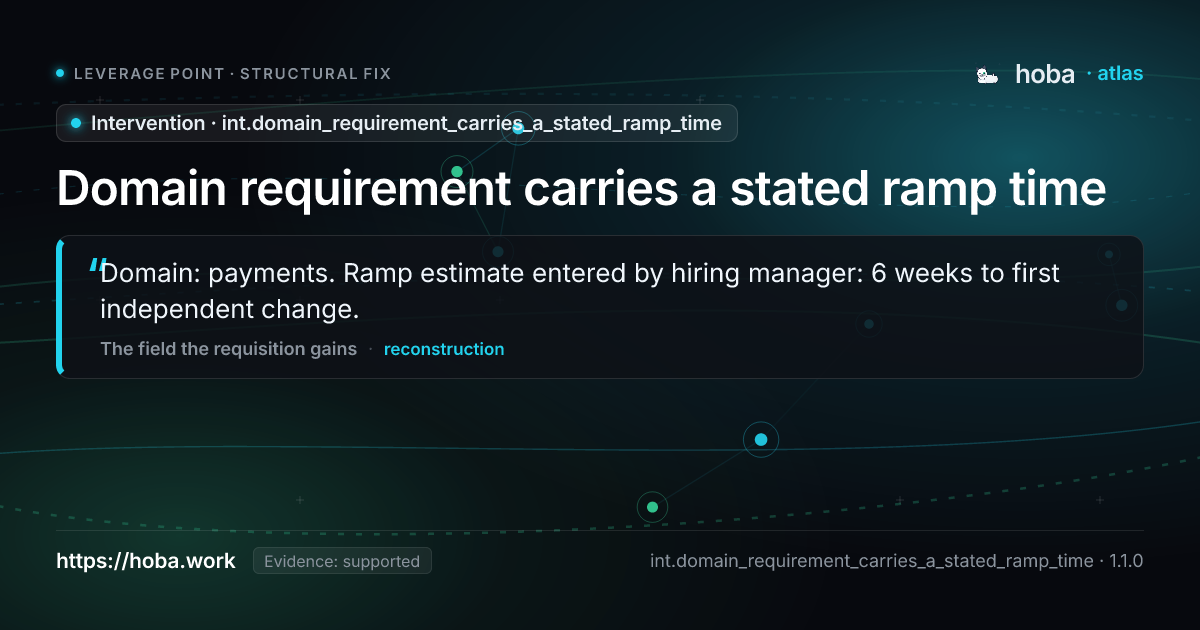
- reqDomain: payments. Ramp estimate entered by hiring manager: 6 weeks to first independent change.
- reqRamp ≤ 12 weeks → scored as preference. Screening may not reject on domain alone.
- reqTo make it a gate, name the regulation, certification or customer commitment that cannot wait 6 weeks.
What to notice: The manager is not asked to drop the preference — they are asked to price it. A vertical that takes six weeks to learn cannot also be the thing that disqualifies someone with ten years of the underlying systems work, and writing the estimate is what makes the two claims meet.
What this targets
Expected effects
- mech.domain_specificity_over_weighting must state its own cost before it can reject
- A requirement assembled from something other than the work becomes visible at the point it is written
What to measure
ramp_estimate_completion_ratedomain_only_rejection_rate
Reached without being linked
The relations above are one step. This is what the entry reaches only by walking through them — the shape of it, since the list runs long in a registry this cross-referenced.
- 16
- Observation5Barrier7Mechanism4
From each side
The same entry from inside each position that meets it: what reaches them, what it means from there, and what happens next given what they control.
- What reaches them
- A screening rule that says which requirements may reject and which may only rank.
- What it means from there
- The instruction that used to arrive as "must have fintech" now arrives with a duration attached, and a duration can be argued with where a preference could not.
- What happens next
- Advances candidates strong on transferable depth where the ramp is short, and cites the estimate when the manager objects.
- What reaches them
- A posting that says how long the team thinks its domain takes to pick up.
- What it means from there
- Whether the vertical is a wall or a ramp is now the employer's stated position rather than something to guess at from a rejection.
- What happens next
- Applies to the roles where the ramp is stated and short, and stops rewriting a CV to fake a vertical.
ATS vendorNot visible from here
From this position the entry is not visible. That is not a gap in the atlas — it is the finding: the decision is made where nobody in this position can see it.
ClientNot visible from here
From this position the entry is not visible. That is not a gap in the atlas — it is the finding: the decision is made where nobody in this position can see it.
Employer policyNot visible from here
From this position the entry is not visible. That is not a gap in the atlas — it is the finding: the decision is made where nobody in this position can see it.
Public policy and industry standardsNot visible from here
From this position the entry is not visible. That is not a gap in the atlas — it is the finding: the decision is made where nobody in this position can see it.