- What reaches them
- A page attached to every technical posting carrying four columns, their weights and the number a total is compared with.
- What it means from there
- A published instrument is one every panel has to score against and one the organisation is answerable to; the columns can no longer be settled after the round.
- What happens next
- Defines which instruments may be published and how a change to one is dated, and holds the publication back for roles where no rubric has been written.
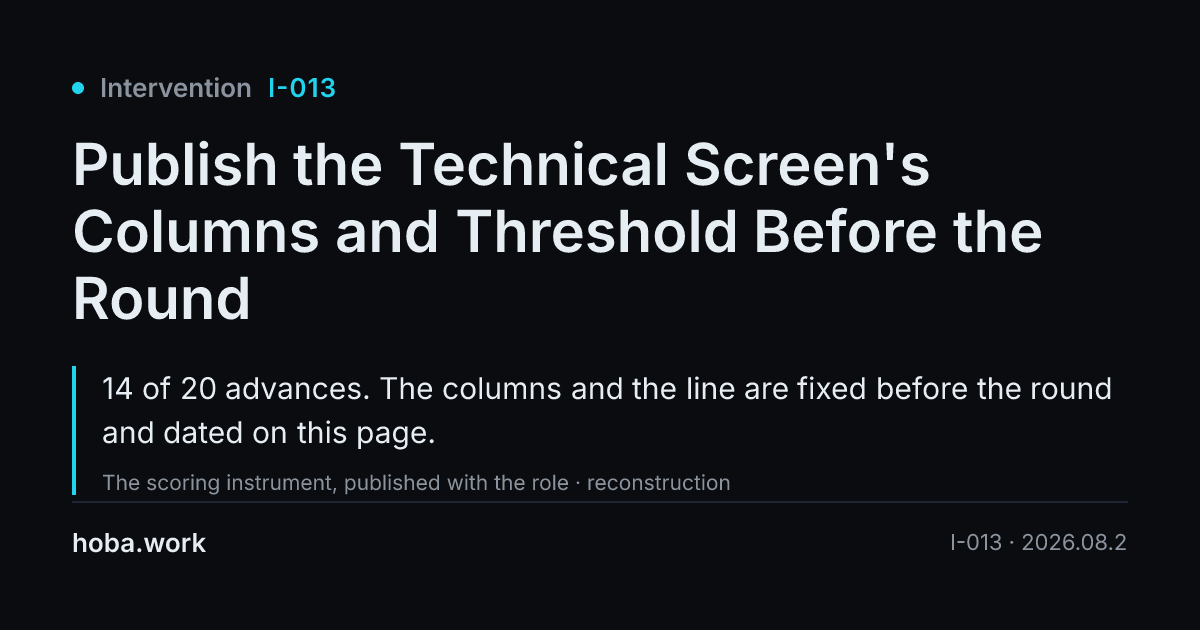
Publish the Technical Screen's Columns and Threshold Before the Round
Publish the columns, their weights and the advancing threshold of the live technical screen alongside the posting, and score the round on those columns.
Intervention I-013 Actor: employer policy Scope: organizational Cost: medium Evidence: hypothesis
On the canonical path
Assessed on the work, against a rubric that is shared — One timeboxed exercise that resembles the job. The candidate is given the criteria before starting, the timebox is enforced against the evaluator as well, and the same rubric scores everyone.
This entry is one of the things that holds that commitment up.
What it looks like when this intervention is in place
Composite excerpts, written to be typical rather than copied. No particular message, company or person is quoted here.
Title: Technical screen — how this hour is scored
Correctness · complexity reasoning · communication · testing instinct. Each 0–5, equal weight.
14 of 20 advances. The columns and the line are fixed before the round and dated on this page.
One implementation task in a shared editor, 45 minutes, run by an engineer from the team the role sits in.
The four column scores are sent with the outcome, whichever way it goes.
What to notice: The gate was already a sum against a line. Publishing does not move the line; it puts the columns and the line on the side of the table where the hour is spent.
What this targets
Expected effects
- B-005's instrument exists before the hour it scores: the columns, the weights and the line are readable from outside the panel
- A total one point under the threshold at B-005 is locatable, because the number it is compared with is published
- A round read cold under M-012 is scored on the published columns rather than on what the hour left as an impression
What to measure
rubric_completion_rateborderline_outcome_rate
From each side
The same entry from inside each position that meets it: what reaches them, what it means from there, and what happens next given what they control.
- What reaches them
- The columns, the weights and the threshold before booking the hour, and the column scores with the outcome.
- What it means from there
- The hour is scored on four named things, so preparation has a target, and a total a point under the line reads as that rather than as a verdict on the person.
- What happens next
- Prepares against the named columns, and where the exercise format does not match what the role does, decides that before spending the hour.
- What reaches them
- The team's rubric as an external document with a date on it, and every panel entry now recorded against those columns.
- What it means from there
- The instrument is fixed before the round, so two interviewers disagreeing becomes a difference in a named column rather than a difference in what was being looked for.
- What happens next
- Writes the columns and the threshold down before the role opens, and takes a change to them through the same publication step rather than mid-search.
ATS vendorNot visible from here
From this position the entry is not visible. That is not a gap in the atlas — it is the finding: the decision is made where nobody in this position can see it.
Public policy and industry standardsNot visible from here
From this position the entry is not visible. That is not a gap in the atlas — it is the finding: the decision is made where nobody in this position can see it.
RecruiterNot visible from here
From this position the entry is not visible. That is not a gap in the atlas — it is the finding: the decision is made where nobody in this position can see it.