- What reaches them
- A configuration line, and the count of open requisitions it would withdraw this quarter, on the same cycle where headcount is reviewed.
- What it means from there
- What is being spent is optionality: a listing that closes on a timer cannot be held open while funding is decided, and reopening it runs the approval chain again.
- What happens next
- Sets the interval and what counts as activity, and decides whether a lapsed authorisation withdraws the listing or only flags it for review.
Auto-Close Stale Job Requisitions
Implement automated ATS policy to expire public listings when headcount authorization lapses or no interview activity occurs within 60 days.
Intervention I-001 Actor: employer policy Scope: organizational Cost: low Evidence: supported
On the canonical path
Published with its terms on the page — The posting states the compensation band, the location rules, the stages the process has and roughly how long each takes. It comes down when the search ends.
Read by a person, inside the stated window — Every application that clears the mechanical stage is read by someone, and read before the window the posting promised runs out.
Approval already exists — Headcount was signed before the role was published, so this step is a countersignature rather than a second decision. If the budget goes, the search closes and everyone inside it is told.
Search closed, and everyone told — A search can legitimately stop: the need changes, the budget goes, someone internal turns out to be right for it. What this path requires is that the posting comes down and every candidate still inside the process is told within days.
This entry is one of the things that holds that commitment up.
What it looks like when this intervention is in place
Composite excerpts, written to be typical rather than copied. No particular message, company or person is quoted here.
- config Policy: expire_listing when headcount_authorisation lapses OR no interview activity for 45 days
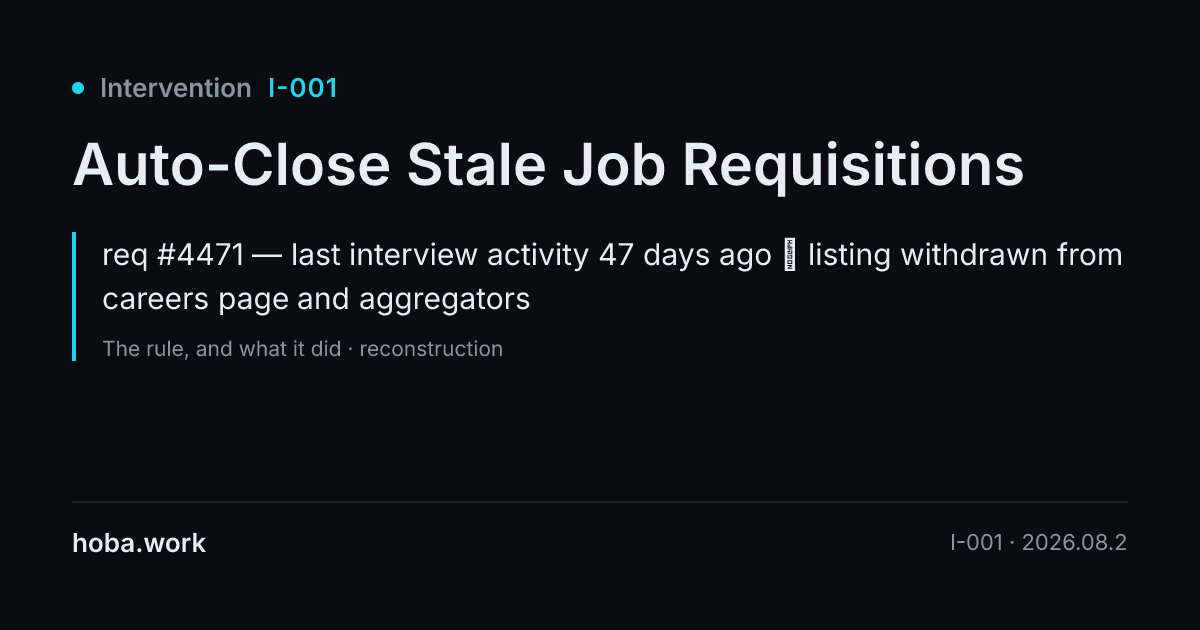
- 02:00 req #4471 — last interview activity 47 days ago → listing withdrawn from careers page and aggregators
- 02:01 Candidates with applications in flight: 84 — each notified that the search has closed, with the date.
What to notice: The same batch job that produces silent bulk rejections can be pointed at the listing instead of the candidate. The cost is a configuration line.
What this targets
Expected effects
- Reduce stale public listings and candidate application waste
- Reduce ambiguous post-application silence
What to measure
stale_requisition_rateclosure_latency_days
From each side
The same entry from inside each position that meets it: what reaches them, what it means from there, and what happens next given what they control.
- What reaches them
- Listings dropping off the careers page overnight, and the batch notification going to every application still in flight against them.
- What it means from there
- A requisition closed on a timer is counted as closed rather than filled, and the pipeline built against it is gone if the search restarts.
- What happens next
- Sends the closure notice with the date on it, and asks for the requisition to be reopened where the manager still intends to hire.
- What reaches them
- A message naming the requisition, the date the search closed, and the reason the listing came down.
- What it means from there
- The process ended for a reason that has nothing to do with the application; there is nothing further to wait for and nothing left to infer.
- What happens next
- Closes the file, stops holding capacity for a possible next round, and reapplies if the role is posted again.
- What reaches them
- A customer enabling an expiry rule pointed at the listing, on the same scheduler that already expires unreviewed applications.
- What it means from there
- This is an existing batch capability with a different target rather than new machinery; whether it runs is a customer setting.
- What happens next
- Ships the rule as a configurable option, and its default value decides how many customers ever run it.
Hiring managerNot visible from here
From this position the entry is not visible. That is not a gap in the atlas — it is the finding: the decision is made where nobody in this position can see it.
Public policy and industry standardsNot visible from here
From this position the entry is not visible. That is not a gap in the atlas — it is the finding: the decision is made where nobody in this position can see it.