- What reaches them
- An hour with the candidate, plus what the earlier rounds recorded. The rounds they did not attend arrive as scores rather than as what was said.
- What it means from there
- An answer about a past trade-off reads as evidence of ownership at the level the role is scoped to.
- What happens next
- Assesses against the requirements as written and the ones that were never written down. A bad hire is attributed and a missed one is not, so an unresolved doubt closes the loop rather than extends it.
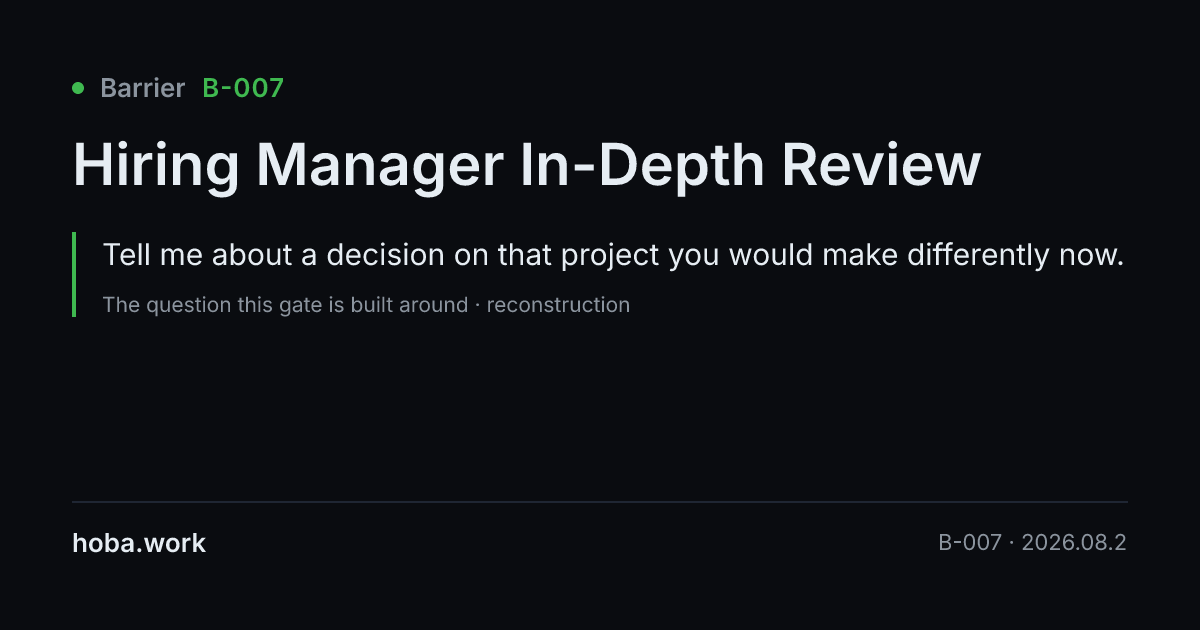
Hiring Manager In-Depth Review
Detailed evaluation of candidate seniority, project ownership history, trade-off reasoning, and team-specific mission fit.
Barrier B-007 Stage: Hiring manager Step in the funnel: #9 Evidence: established
On the canonical path
One panel, one question each, one decision rule — Every interviewer knows what they are measuring and that nobody else is measuring it. The rule that turns their scores into a decision is agreed before the first conversation, and no round is added after the process has started.
This entry is one of the ways that commitment stops being kept.
What it looks like
Composite excerpts, written to be typical rather than copied. No particular message, company or person is quoted here.
- 18:04 Hiring manager Tell me about a decision on that project you would make differently now.
- 18:12 Candidate We picked synchronous calls between two services because it was faster to ship. It cost us during incidents — a queue would have been the right call.
- 18:40 Hiring manager What made you choose speed at the time?
- 18:46 Candidate A launch date we had committed to externally.
What to notice: This gate is testing ownership and trade-off reasoning, not knowledge. It is also the gate where an undisclosed house preference does the most damage.
Barriers before this one
Barriers after this one
Mechanisms operating at this barrier (8)
- M-001 Genuine Technical Skill Shortfall candidate The candidate’s verified technical execution or domain depth does not meet the established baseline for the role level.
- M-002 Stronger Competing Candidate in Final Cohort none Candidate cleared all passing bars, but another applicant in the same pipeline demonstrated superior domain overlap or lower onboarding overhead.
- M-005 Pre-Selected Internal Candidate none Requisition was publicly advertised to satisfy corporate policy or legal compliance while an internal employee was already earmarked for the role.
- M-010 Hidden Evaluation Rubric or Undisclosed Priority intermediary The interview team grades candidate against specific undisclosed architectural dogmas, internal frameworks, or unwritten biases.
- M-012 Interview Resource & Scheduling Saturation intermediary Engineering interviewers are overwhelmed with sprint commitments, leading to calendar fragmentation, rush reviews, or dropped loops.
- M-013 Mid-Process Role Requirement Redefinition none Team changes tech stack, seniority requirements, or project scope mid-funnel, invalidating previous interview assessments.
- M-017 Experience-Age Grading Mismatch none Candidate with 10+ years applied for mid/senior role, triggering fears of boredom, rapid churn, or salary dissatisfaction.
- M-018 Domain Specificity Over-Weighting intermediary Interviewer requires exact vertical experience (e.g. adtech, crypto, specific payment processor) over deep transferable systems fundamentals.
Interventions targeting this barrier
From each side
The same entry from inside each position that meets it: what reaches them, what it means from there, and what happens next given what they control.
- What reaches them
- Questions about past decisions, and no statement of which answers are scored or at what level.
- What it means from there
- A conversational round reads as rapport rather than as an assessment against a written bar.
- What happens next
- Chooses which projects to describe and in what depth, without knowing the house preference the answer is compared against. The available lever is to ask what the level and the rubric are before answering.
- What reaches them
- A recommendation and a date. The reasoning behind it arrives as a summary line, not as the manager's notes.
- What it means from there
- An advance is a pipeline step cleared; a decline here is a rejection to be worded without the reasoning that produced it.
- What happens next
- Moves the candidate to the panel, or sends the decline in standard wording, since the requirement behind it is not in what reached them.
ATS vendorNot visible from here
From this position the entry is not visible. That is not a gap in the atlas — it is the finding: the decision is made where nobody in this position can see it.
Employer policyNot visible from here
From this position the entry is not visible. That is not a gap in the atlas — it is the finding: the decision is made where nobody in this position can see it.
Public policy and industry standardsNot visible from here
From this position the entry is not visible. That is not a gap in the atlas — it is the finding: the decision is made where nobody in this position can see it.