- What reaches them
- A repository and a scoring form, opened between the team's own delivery work. The hours the submission took are not a field on the form.
- What it means from there
- A score against the rubric reads as the work this candidate would produce on the team.
- What happens next
- Advances or declines on the returned scores. A second read is scheduled where the two reviewers disagree, and not otherwise.
Take-Home / Work Sample Evaluation
Asynchronous technical assignment or project artifact reviewed by engineering peers against quality benchmarks.
Barrier B-006 Stage: Technical Step in the funnel: #8 Evidence: established
On the canonical path
Assessed on the work, against a rubric that is shared — One timeboxed exercise that resembles the job. The candidate is given the criteria before starting, the timebox is enforced against the evaluator as well, and the same rubric scores everyone.
This entry is one of the ways that commitment stops being kept.
What it looks like
Composite excerpts, written to be typical rather than copied. No particular message, company or person is quoted here.
Submission received: 41 files, 78 tests, README with design rationale.
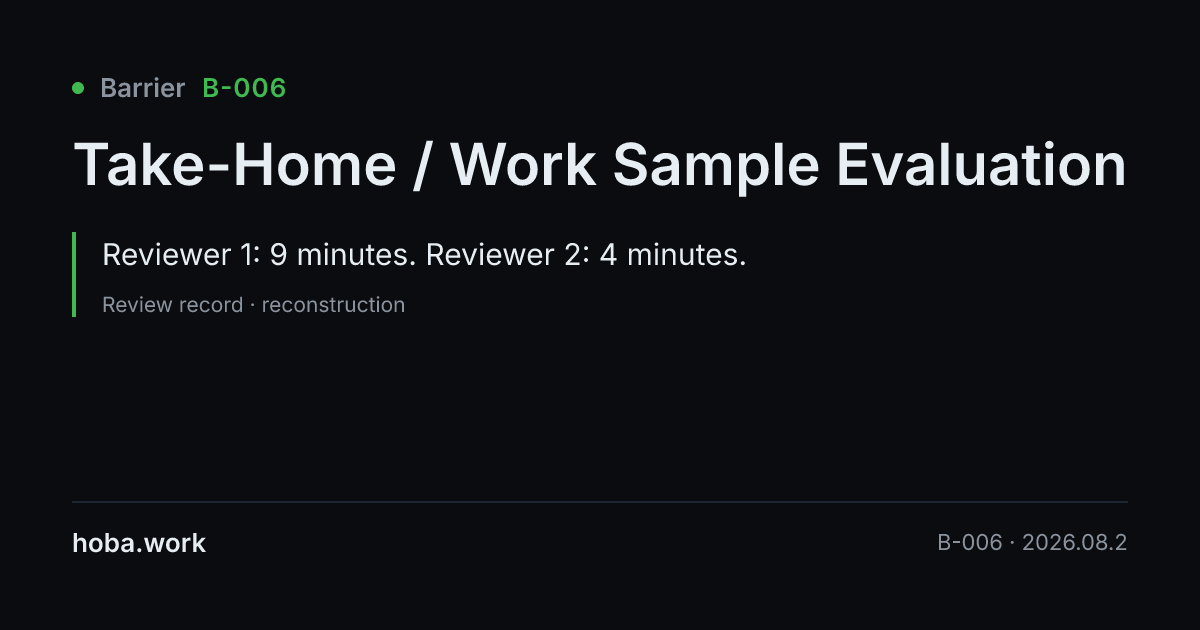
Reviewer 1: 9 minutes. Reviewer 2: 4 minutes.
Scored on: architecture, test coverage, documentation, commit hygiene.
Outcome: advance.
What to notice: This gate compares hours of work against minutes of review. It can pass or fail on what a reader happened to open.
Barriers before this one
Barriers after this one
Mechanisms operating at this barrier (2)
- M-001 Genuine Technical Skill Shortfall candidate The candidate’s verified technical execution or domain depth does not meet the established baseline for the role level.
- M-019 Take-Home Evaluation Fatigue & Asymmetry none Reviewers perform hurried 5-minute scans of complex 15-hour take-home projects, missing subtle architectural patterns and tests.
Interventions targeting this barrier
From each side
The same entry from inside each position that meets it: what reaches them, what it means from there, and what happens next given what they control.
- What reaches them
- A brief, a deadline, and a scope the candidate sets inside it. After submission, a verdict with no reference to any particular file.
- What it means from there
- The hours spent read as the unit this gate measures, and a decline reads as a judgement on the code.
- What happens next
- Builds to the upper bound of the brief, because the brief states a scope and not a review depth. What is left afterwards is the dates and the wording of the verdict.
- What reaches them
- The date the assignment went out, the date it came back, and a line of recommendation. The submission itself is not in the fields the recruiter works from.
- What it means from there
- The gate reads as an interval in the pipeline: days between dispatch and a decision that can be acted on.
- What happens next
- Follows up with the reviewers as the interval grows, and writes the outcome from the recommendation, since the notes behind it do not reach the recruiter.
ATS vendorNot visible from here
From this position the entry is not visible. That is not a gap in the atlas — it is the finding: the decision is made where nobody in this position can see it.
Employer policyNot visible from here
From this position the entry is not visible. That is not a gap in the atlas — it is the finding: the decision is made where nobody in this position can see it.
Public policy and industry standardsNot visible from here
From this position the entry is not visible. That is not a gap in the atlas — it is the finding: the decision is made where nobody in this position can see it.