- What reaches them
- A request for a compensation expectation at the screen, and a band that is not stated in return.
- What it means from there
- The number is collected before the level is fixed, so it is an input to the level rather than an answer to it.
- What happens next
- Names a range without the band, without the level, and without knowing how many others in the pipeline have already named one.
Compensation Double Bind
Candidate is required to state salary expectation first; quoting high triggers immediate rejection, while quoting low triggers leveling downranking.
Pattern P-004 Evidence: supported
Trigger Rule
Asymmetric salary inquiry where employer refuses band disclosure prior to candidate submitting binding number.
What it looks like
Composite excerpts, written to be typical of this signal. They are not copies of any particular message, company or person.
- screen, minute 3 Recruiter Before we go further — what are your compensation expectations?
- screen, minute 3 Candidate Happy to discuss. What is the band for the role?
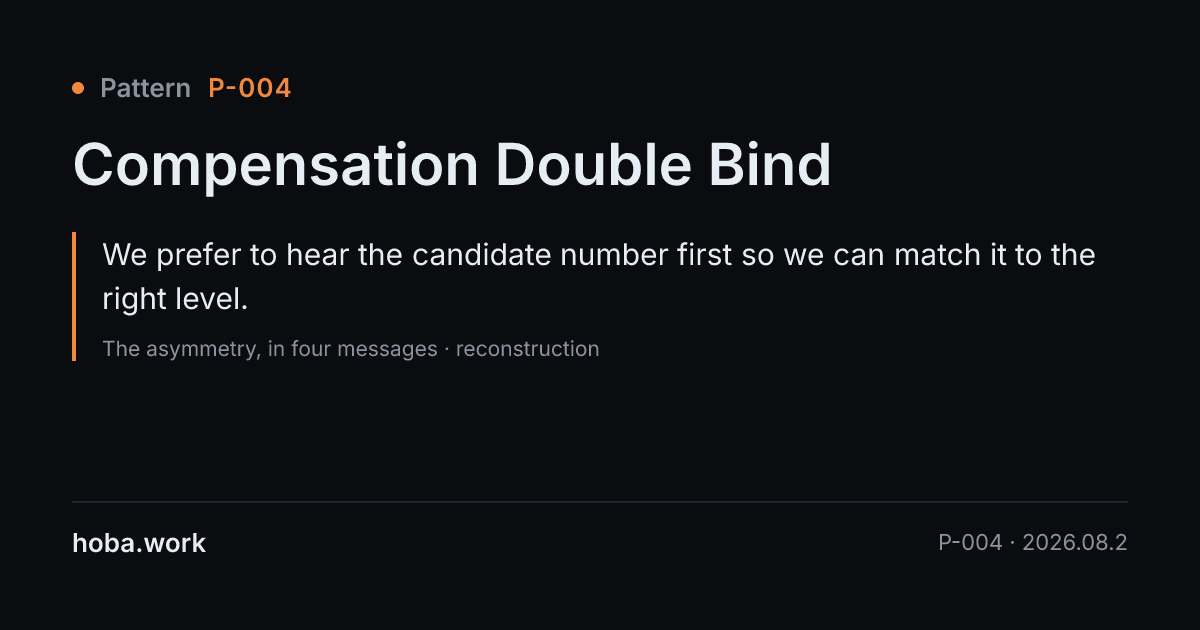
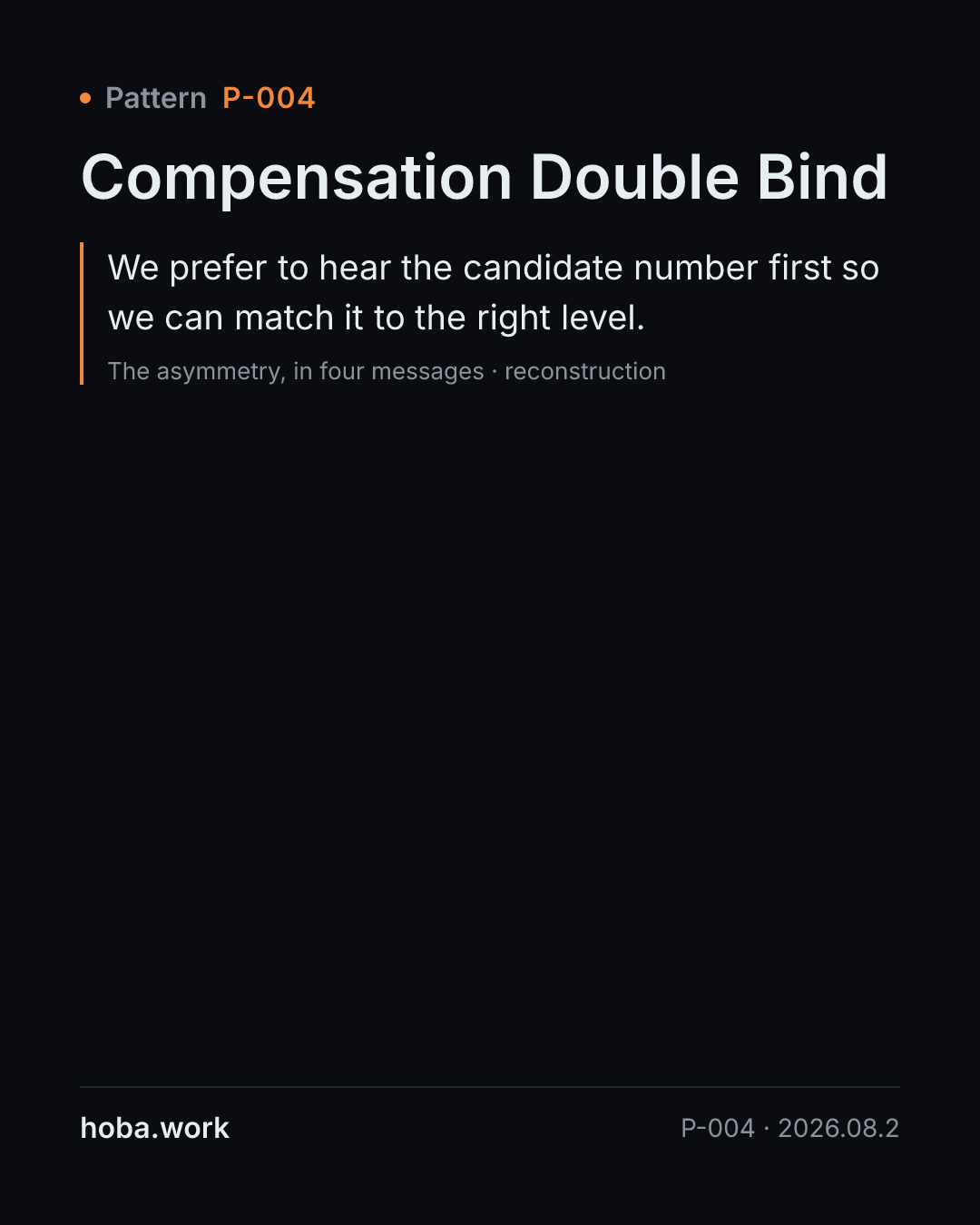
- screen, minute 4 Recruiter We prefer to hear the candidate number first so we can match it to the right level.
- screen, minute 5 Candidate Understood. My expectation is in the range of 85–95k.
What to notice: The number is required from one side and withheld by the other, and it is collected before the level is fixed. Both outcomes below follow from that ordering.
Quoted 95k — We are not able to proceed; the expectation is outside the range we have for this role.
Quoted 70k — Good news, we would like to move ahead. Based on the conversation we are looking at this as a mid-level hire rather than senior.
What to notice: A high number ends the process and a low one moves the level. There is no answer that leaves both the process and the grade untouched — which is what makes it a bind rather than a negotiation.
What this pattern establishes
- Information asymmetry is utilized as an uncalibrated gatekeeper before technical merit is evaluated.
What this does NOT establish
- Does not mean employer has unlimited budget or malice.
Required observed signals (artifacts)
- A-002 Generic "closer alignment" rejection template Standard automated email stating the team decided to proceed with candidates whose profiles more closely match role requirements.
- A-005 Compensation band reduced or altered mid-process Offered or discussed compensation band is revised downward from previously agreed or advertised range.
Compatible mechanisms participating in the motif
- M-004 Unstated Compensation Band Discrepancy intermediary Candidate market rate exceeds budgeted compensation for the requisition, but salary band was never published or clarified early.
- M-017 Experience-Age Grading Mismatch none Candidate with 10+ years applied for mid/senior role, triggering fears of boredom, rapid churn, or salary dissatisfaction.
Interventions mitigating this contradiction pattern
From each side
The same entry from inside each actor that meets it. What reaches them, what it means from there, and what happens next given what they control.
- What reaches them
- A screening form with an expectations field that has to be filled before the candidate moves to the panel, and disclosure rules for the band that are set elsewhere.
- What it means from there
- The number is the cheapest available check on whether the process is viable, before panel time is spent on it.
- What happens next
- Asks for the number first and records it in the field, and says about the band exactly what is permitted at this stage.
- What reaches them
- A band per level and a rule about what may be said about it, both reviewed on a cycle measured in quarters.
- What it means from there
- A stated expectation is the input that places a candidate on the grid; a band stated first becomes the floor of every negotiation that follows.
- What happens next
- Publishes the band where a disclosure rule requires it and not elsewhere, and keeps levelling a decision separate from the number.
Public policy and industry standards
- What reaches them
- Postings in covered jurisdictions, which either carry a band or do not.
- What it means from there
- A published band is measurable and enforceable; the level a candidate will be assessed at is neither.
- What happens next
- Requires the band in the posting, which closes one branch of the bind and leaves the levelling branch untouched.
ATS vendorNot visible from here
This entry has no view from this position. That is not an oversight in the atlas — it is the finding: a decision made where nobody in this seat can see it.
Hiring managerNot visible from here
This entry has no view from this position. That is not an oversight in the atlas — it is the finding: a decision made where nobody in this seat can see it.