- What reaches them
- Two rejections inside one market cycle: one saying the experience sits above the band scoped for the role, one saying the depth is not yet at the next level's scope.
- What it means from there
- Together the two messages describe a person who is above one rung and below the next, with nothing open in between.
- What happens next
- Applies at both levels at once and shifts what the CV emphasises depending on which rung the posting names.
Seniority Double Bind
Candidate is simultaneously rejected as overqualified for junior/mid roles and underqualified (or insufficiently specialized) for staff/leadership roles.
Pattern P-001 Evidence: supported
What made this ordinary
A fixed number of seats · 2024–2026 — The conditions that made hiring expensive were reversed; the number of positions was not. The contraction now runs through the hiring channel rather than the separation channel, which is why it is competition for a fixed and shrinking number of seats rather than a shortage of qualified people.
Trigger rule
Candidate observes rejection for overqualification at level N and skill-depth shortfall at level N+1 within the same market cycle.
What it looks like
Composite excerpts, written to be typical rather than copied. No particular message, company or person is quoted here.
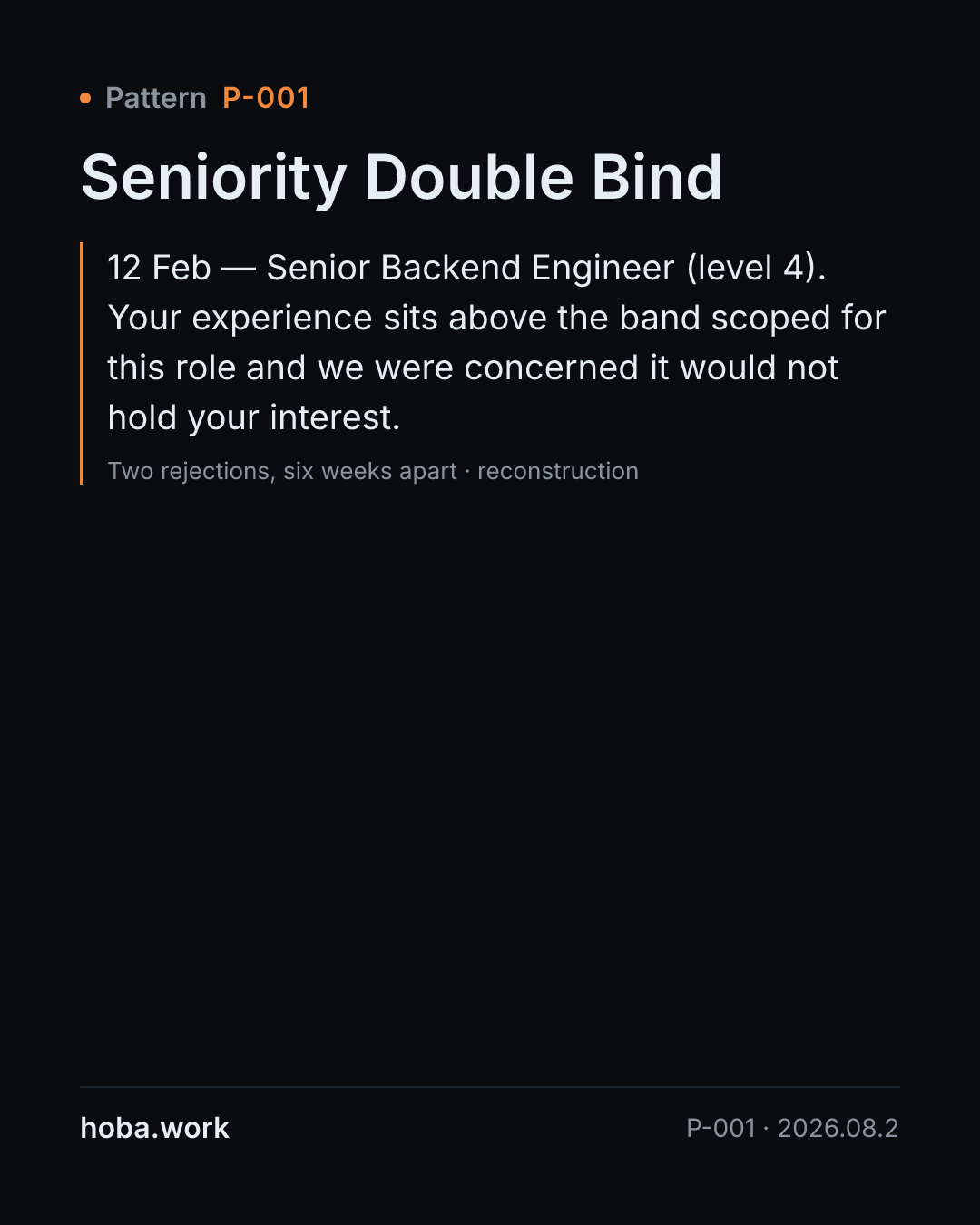
12 Feb — Senior Backend Engineer (level 4). Your experience sits above the band scoped for this role and we were concerned it would not hold your interest.
26 Mar — Staff Engineer (level 5). The panel felt the depth of platform ownership was not yet at staff scope; we would look for a broader track record of org-wide impact.
Both roles: same city, same domain, same six-week window.
What to notice: Neither message is unreasonable on its own. Put next to each other they describe a candidate who is above one level and below the next, with nothing in between open.
Established: two rejections, two stated grounds, two adjacent levels, one market cycle.
Not established: that either judgement was wrong, that the two employers coordinated, or that the candidate is unhireable. The motif is a property of the level grid, not of the person moving through it.
What to notice: The pattern is worth naming precisely because each half is defensible. The trap is structural, which is also why no single conversation can argue it away.
What this pattern establishes
- Candidate falls into an evaluation boundary gap where compensation/experience expectations mismatch standard job tiers.
What this does NOT establish
- Does not establish that the candidate lacks market value.
- Does not establish malice or coordinated collusion between employers.
Observations this pattern requires
- A-002 Generic "closer alignment" rejection template Standard automated email stating the team decided to proceed with candidates whose profiles more closely match role requirements.
- A-013 Feedback stating candidate is overqualified for the grade Candidate is rejected on the grounds that their experience, seniority, or previous scope exceeds the open position tier.
Compatible mechanisms in this pattern
- M-001 Genuine Technical Skill Shortfall candidate The candidate’s verified technical execution or domain depth does not meet the established baseline for the role level.
- M-004 Unstated Compensation Band Discrepancy intermediary Candidate market rate exceeds budgeted compensation for the requisition, but salary band was never published or clarified early.
- M-017 Experience-Age Grading Mismatch none Candidate with 10+ years applied for mid/senior role, triggering fears of boredom, rapid churn, or salary dissatisfaction.
Interventions that mitigate this pattern
- I-002 Upfront Compensation Band Disclosure Publish verified salary and equity bands directly in job descriptions or disclose them prior to scheduling technical interview rounds.
- I-003 Standardized Late-Stage Rejection Feedback Taxonomy Provide candidates reaching technical or panel stages with structured, rubric-based feedback categories rather than generic templates.
From each side
The same entry from inside each position that meets it: what reaches them, what it means from there, and what happens next given what they control.
- What reaches them
- A profile whose years and previous scope sit above the band approved for the requisition being screened.
- What it means from there
- An expectation above the band reads as an offer that will not close, and the level of the requisition is fixed before the screen begins.
- What happens next
- Closes the application against this requisition and writes the rejection in terms of fit with the level it was opened at.
- What reaches them
- A candidate in a staff-level round, assessed against the scope the panel has agreed for that level: ownership across an organisation rather than a team.
- What it means from there
- A track record that has not yet run at that scope is a risk that lands on the person who makes the hire.
- What happens next
- Records a not-at-this-level decision and leaves the requisition open: a bad hire carries a name and a search still running does not.
- What reaches them
- A levelling grid in which every level has a band and the bands are contiguous, and requisitions that are each opened at a single level.
- What it means from there
- A candidate above one band and below the next is a mismatch between a person and a particular requisition, not a gap in the grid; the grid is what makes offers consistent across every hire.
- What happens next
- Holds the grid steady through the cycle and approves requisitions at one level, because the level is the unit finance funds.
ATS vendorNot visible from here
From this position the entry is not visible. That is not a gap in the atlas — it is the finding: the decision is made where nobody in this position can see it.
Public policy and industry standardsNot visible from here
From this position the entry is not visible. That is not a gap in the atlas — it is the finding: the decision is made where nobody in this position can see it.