- What reaches them
- An approval form with one requirement list to cover the whole of what the role might have to absorb, and a level that has to be justified against the grid.
- What it means from there
- The list is the only written statement of the ceiling. A requirement left off cannot be screened for later without going back through approval.
- What happens next
- Writes the superset — the whole stack, the seniority the level needs — and calibrates afterwards against real candidates, in the screen and on the panel.
Inflated Requisition Requirements vs Actual Team Needs
Job description demands 10+ niche technologies and Staff-level qualifications for a straightforward feature engineering role.
Mechanism M-024 Intermediary dependent Actor: hiring managerNature: incentiveVisibility: inferableAgency zone: intermediaryEvidence: supported
On the canonical path
A real opening, described honestly — The requisition describes work that exists now, at a level the team actually needs, inside a band the budget already covers. Nothing here is aspirational: the list of requirements is what the job uses, not what the last four candidates happened to have.
This entry is one of the ways that commitment stops being kept.
What made this ordinary
A fixed number of seats · 2024–2026 — The conditions that made hiring expensive were reversed; the number of positions was not. The contraction now runs through the hiring channel rather than the separation channel, which is why it is competition for a fixed and shrinking number of seats rather than a shortage of qualified people.
What it looks like
Composite excerpts, written to be typical rather than copied. No particular message, company or person is quoted here.
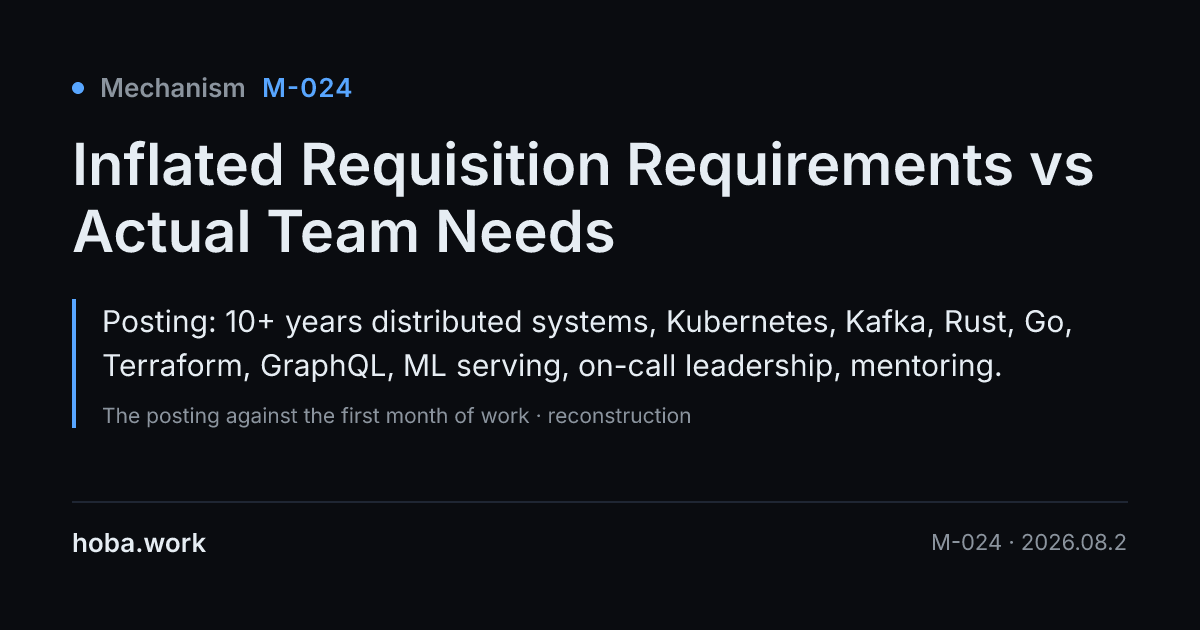
Posting: 10+ years distributed systems, Kubernetes, Kafka, Rust, Go, Terraform, GraphQL, ML serving, on-call leadership, mentoring.
Same team, standup notes from the quarter: CRUD endpoints for the billing dashboard, a report export, two library upgrades.
Both descriptions are of the same role.
What to notice: The requirement list is a wish, an anchor and a filter at once. It describes the ceiling somebody imagined, not the work in the sprint.
Barriers where this mechanism operates
Observations this mechanism emits
What this does NOT establish
- Failing to meet an inflated "wishlist" does not mean candidate cannot excel at the team’s actual core tasks.
Causal relations
From each side
The same entry from inside each position that meets it: what reaches them, what it means from there, and what happens next given what they control.
- What reaches them
- The requirement list as written, and a pipeline that thins under it. What the manager requires but has not written down is not visible from here.
- What it means from there
- Until the manager says otherwise, the list is the screening standard, and the pool that clears it is small.
- What happens next
- Screens against the written list, then goes back to the manager to find which items are movable — while time-to-fill runs from the day the requisition opened.
- What reaches them
- The requirement list as configurable criteria: years, titles, named technologies, each one a feature the ranking model can read or a knockout rule the customer can switch on.
- What it means from there
- Every listed item is a requirement. Nothing in the record separates what the role needs from what someone hoped for.
- What happens next
- Applies the criteria as configured and ranks accordingly. A longer list yields a smaller qualified pool, and the pool size is what the customer sees.
- What reaches them
- A posting listing a stack of named technologies and a seniority level, and later the same role posted again.
- What it means from there
- The list is the bar. Which items are load-bearing is stated nowhere the candidate can reach, and neither is the level they would be assessed at.
- What happens next
- Either does not apply to a role whose actual work is within reach, or applies and spends the hours; when the role reappears, there is nothing available to tell an unmet bar from a list nobody clears.
Employer policyNot visible from here
From this position the entry is not visible. That is not a gap in the atlas — it is the finding: the decision is made where nobody in this position can see it.
Public policy and industry standardsNot visible from here
From this position the entry is not visible. That is not a gap in the atlas — it is the finding: the decision is made where nobody in this position can see it.