- What reaches them
- A debrief that does not resolve: two for, two against, with no calibration record that would weigh one interviewer's bar against another's.
- What it means from there
- Absent a reason to override, the split is the answer. A bad hire is visible for a year and has a name on it; a candidate not hired leaves nothing to be asked about.
- What happens next
- Applies the default and records the outcome in the fit wording the debrief form accepts, which is what the rest of the process then sees.
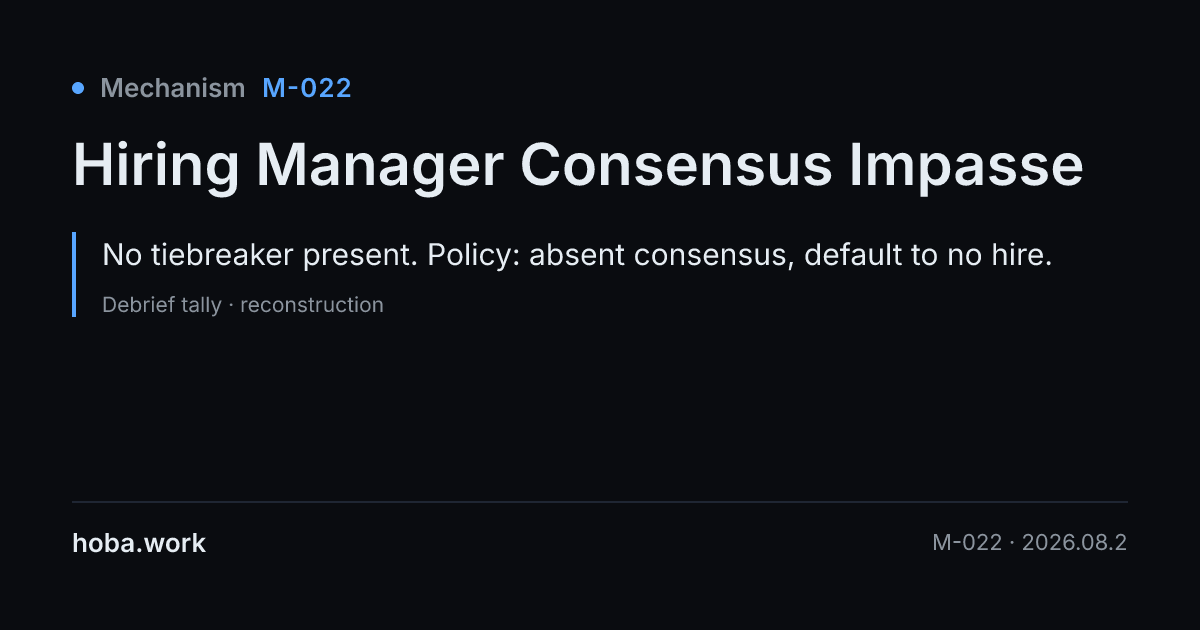
Hiring Manager Consensus Impasse
The interview panel splits 50/50 without an executive tiebreaker, defaulting conservatively to a "no-hire" decision.
Mechanism M-022 Exogenous (no agency) Actor: hiring managerNature: biasVisibility: opaqueAgency zone: noneEvidence: supported
On the canonical path
One panel, one question each, one decision rule — Every interviewer knows what they are measuring and that nobody else is measuring it. The rule that turns their scores into a decision is agreed before the first conversation, and no round is added after the process has started.
This entry is one of the ways that commitment stops being kept.
What it looks like
Composite excerpts, written to be typical rather than copied. No particular message, company or person is quoted here.
Interviewer A: hire. Interviewer B: hire. Interviewer C: no hire. Interviewer D: no hire.
No tiebreaker present. Policy: absent consensus, default to no hire.
Outcome recorded as: not aligned with team needs.
What to notice: A 2–2 split became a rejection by rule, and the rule was then written up as a judgement about the candidate.
Barriers where this mechanism operates
Observations this mechanism emits
What this does NOT establish
- Split panel reflects lack of calibrated internal standards rather than candidate failure.
Causal relations
From each side
The same entry from inside each position that meets it: what reaches them, what it means from there, and what happens next given what they control.
- What reaches them
- A debrief that closes without a recommendation, and an outcome field set to no hire with no single reason attached to it.
- What it means from there
- The requisition is open again and the pipeline restarts. What the panel actually scored is not visible from here.
- What happens next
- Sends the standard rejection, since there is no agreed reason to convey, and reopens sourcing against a bar written down no more clearly than before.
- What reaches them
- Feedback from one round naming architectural depth as a strength, another naming technical background as a gap, then a rejection citing fit.
- What it means from there
- Two assessments of the same performance that cannot both hold. From here they read as an assessment of the candidate rather than of a room that did not agree.
- What happens next
- Sets out to close a gap that half the panel did not record, and keeps both statements with their dates.
ATS vendorNot visible from here
From this position the entry is not visible. That is not a gap in the atlas — it is the finding: the decision is made where nobody in this position can see it.
Employer policyNot visible from here
From this position the entry is not visible. That is not a gap in the atlas — it is the finding: the decision is made where nobody in this position can see it.
Public policy and industry standardsNot visible from here
From this position the entry is not visible. That is not a gap in the atlas — it is the finding: the decision is made where nobody in this position can see it.