- What reaches them
- A CV with years and scope above the level the requisition is graded and funded at, and a screening queue larger than the week's capacity.
- What it means from there
- A forecast about retention and salary expectation, formed before any technical signal exists. The band is fixed and the level is not the recruiter's to change.
- What happens next
- Passes at screening, or asks the hiring manager whether they want the profile at the level above — which is a different requisition.
Experience-Age Grading Mismatch
Candidate with 10+ years applied for mid/senior role, triggering fears of boredom, rapid churn, or salary dissatisfaction.
Mechanism M-017 Exogenous (no agency) Actor: recruiterNature: biasVisibility: inferableAgency zone: noneEvidence: supported
On the canonical path
Terms compared before anyone spends time — Band, level, location, notice period and start date are put side by side in the first conversation, before any assessment is scheduled. Either side can stop here at no cost to the other.
This entry is one of the ways that commitment stops being kept.
What made this ordinary
A fixed number of seats · 2024–2026 — The conditions that made hiring expensive were reversed; the number of positions was not. The contraction now runs through the hiring channel rather than the separation channel, which is why it is competition for a fixed and shrinking number of seats rather than a shortage of qualified people.
What it looks like
Composite excerpts, written to be typical rather than copied. No particular message, company or person is quoted here.
12 years experience against a role scoped at 4–6.
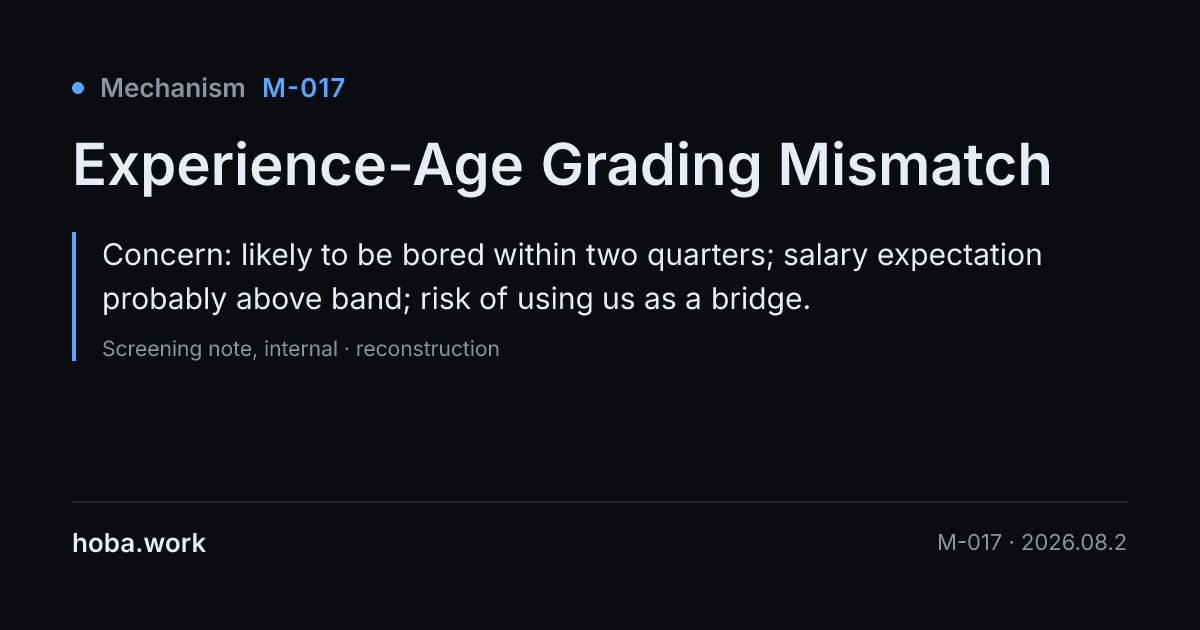
Concern: likely to be bored within two quarters; salary expectation probably above band; risk of using us as a bridge.
Recommend: pass, unless the manager wants to see them for the level above.
What to notice: Every line is a forecast about the future, none is an observation about the work. This is why the rejection can arrive before any technical signal exists.
Barriers where this mechanism operates
Observations this mechanism emits
What this does NOT establish
- Being rejected as "overqualified" is an organizational tier mismatch, not a candidate deficiency.
Causal relations
From each side
The same entry from inside each position that meets it: what reaches them, what it means from there, and what happens next given what they control.
- What reaches them
- A rejection naming seniority or overqualification, arriving before any technical stage, for a role whose posted band was acceptable.
- What it means from there
- A decision about a future they were not asked about. Nothing in it separates a levelling grid from a judgement about the work.
- What happens next
- Records the stage the rejection arrived at, and names a salary expectation at the screen of the next process rather than after it.
- What reaches them
- A levelling grid mapping years and scope to a band, and requisitions approved at one level at a time.
- What it means from there
- Consistency across every hire, which is what the grid exists for. The applications the grid excludes do not reach this layer.
- What happens next
- Holds the grid and the band, and any exception moves through the levelling committee on its own cycle rather than through the process in progress.
ATS vendorNot visible from here
From this position the entry is not visible. That is not a gap in the atlas — it is the finding: the decision is made where nobody in this position can see it.
Hiring managerNot visible from here
From this position the entry is not visible. That is not a gap in the atlas — it is the finding: the decision is made where nobody in this position can see it.
Public policy and industry standardsNot visible from here
From this position the entry is not visible. That is not a gap in the atlas — it is the finding: the decision is made where nobody in this position can see it.