- What reaches them
- The exchange as it happened under time pressure, and a rejection that names fit or collaboration without pointing at a moment.
- What it means from there
- A short answer given while still working on the problem, and a note about it that cannot be read back. There is nothing to check the reading against.
- What happens next
- Reconstructs the session from memory and changes how disagreement is phrased in the next one.
Communication or Working Style Friction
Candidate demonstrated abrasive tone, defensive reactions to critique, or inability to listen during collaborative interview problem solving.
Mechanism M-015 Candidate action Honest baseline Actor: candidateNature: biasVisibility: observableAgency zone: candidateEvidence: established
On the canonical path
One panel, one question each, one decision rule — Every interviewer knows what they are measuring and that nobody else is measuring it. The rule that turns their scores into a decision is agreed before the first conversation, and no round is added after the process has started.
This entry is one of the ways that commitment stops being kept.
What it looks like
Composite excerpts, written to be typical rather than copied. No particular message, company or person is quoted here.
- 33:02 Interviewer I think this loop is doing more work than it needs to.
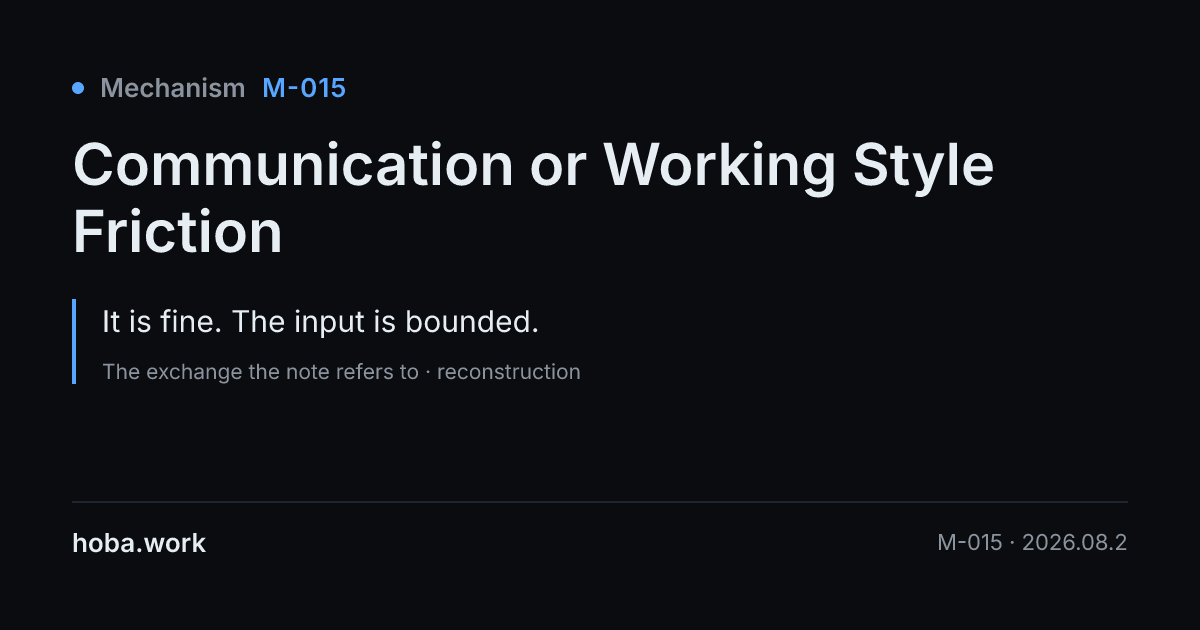
- 33:06 Candidate It is fine. The input is bounded.
- 33:11 Interviewer Sure, but if it were not?
- 33:14 Candidate Then I would change it. But it is.
What to notice: The panel recorded this as resistance to critique. A short answer under time pressure and a defensive posture look identical in a transcript — which is why this belongs in the honest-baseline set and not in the excuses.
Barriers where this mechanism operates
Observations this mechanism emits
What this does NOT establish
- Style friction during high-stress interview is not a permanent personality defect.
From each side
The same entry from inside each position that meets it: what reaches them, what it means from there, and what happens next given what they control.
- What reaches them
- The panel's written impressions of how a disagreement went, alongside the technical scores. No recording, and each interviewer saw a different half hour.
- What it means from there
- A signal about how the person takes review in a team that has to work with them daily. A bad hire on this axis is visible for a year and has a name on it.
- What happens next
- Weighs the impression against the technical notes, and where the panel is split resolves it toward the more conservative outcome.
- What reaches them
- A panel recommendation with the reason recorded as style or fit, and no transcript behind it.
- What it means from there
- A decision that is final and hard to put in writing to the candidate without it reading as a judgement about the person.
- What happens next
- Sends the standard closer-alignment wording, or relays the specific note if the panel has phrased it as something the candidate can act on.
ATS vendorNot visible from here
From this position the entry is not visible. That is not a gap in the atlas — it is the finding: the decision is made where nobody in this position can see it.
Employer policyNot visible from here
From this position the entry is not visible. That is not a gap in the atlas — it is the finding: the decision is made where nobody in this position can see it.
Public policy and industry standardsNot visible from here
From this position the entry is not visible. That is not a gap in the atlas — it is the finding: the decision is made where nobody in this position can see it.