- What reaches them
- The scope the role has to absorb has moved since the requisition was written, and the panel notes in front of them were taken against the earlier description.
- What it means from there
- Strong notes against a target that no longer exists. Re-running four rounds costs the team weeks it is already short of.
- What happens next
- Rewrites the requirements, re-scores the existing notes against them, and decides at which level, if any, the candidate is still a candidate.
Mid-Process Role Requirement Redefinition
Team changes tech stack, seniority requirements, or project scope mid-funnel, invalidating previous interview assessments.
Mechanism M-013 Exogenous (no agency) Actor: hiring managerNature: noiseVisibility: inferableAgency zone: noneEvidence: supported
On the canonical path
One panel, one question each, one decision rule — Every interviewer knows what they are measuring and that nobody else is measuring it. The rule that turns their scores into a decision is agreed before the first conversation, and no round is added after the process has started.
This entry is one of the ways that commitment stops being kept.
What made this ordinary
Rates up, payroll repriced · 2022–2023 — The policy rate reached its cycle peak, technology equities repriced, every stage of the private funding chain contracted at once, and software payroll became something to amortise rather than deduct. The correction ran through announced reductions rather than through attrition.
What it looks like
Composite excerpts, written to be typical rather than copied. No particular message, company or person is quoted here.
Thank you for the four rounds — the panel notes were strong throughout.
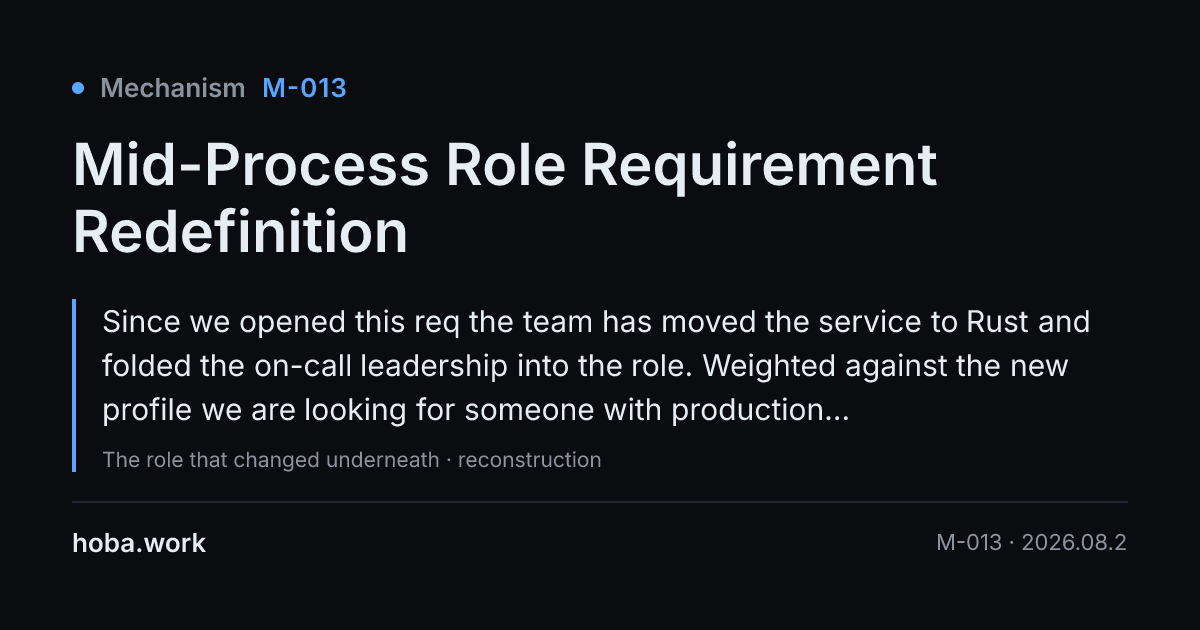
Since we opened this req the team has moved the service to Rust and folded the on-call leadership into the role. Weighted against the new profile we are looking for someone with production Rust and formal lead experience.
I recognise you interviewed against the previous description. I am sorry about that.
What to notice: The assessments were not re-run, they were re-scored against a target that moved after they were taken.
Barriers where this mechanism operates
Observations this mechanism emits
What this does NOT establish
- Candidate rejection was driven by shifting team mandate, not prior interview answers.
Causal relations
From each side
The same entry from inside each position that meets it: what reaches them, what it means from there, and what happens next given what they control.
- What reaches them
- A requisition whose description changes while candidates are mid-loop, and a hiring manager asking for a profile that was not in the original brief.
- What it means from there
- The pipeline built for the old brief no longer converts, and time-to-fill keeps counting from the date the requisition first opened.
- What happens next
- Restates the role to everyone still in process, or closes them out with the standard wording and sources again against the new description.
- What reaches them
- Four rounds of positive signal, then a rejection describing a role different from the one applied to, and a materially similar posting on the board afterwards.
- What it means from there
- The rounds were passed and the target moved, or the rounds were not passed and the changed description is the courteous version. Both readings fit the same email.
- What happens next
- Records the original description, the dates, and the wording of the change, and decides whether to ask which requirement is the new one.
- What reaches them
- An amended requisition arriving for re-approval at a different level or band, with the original still counted as open.
- What it means from there
- A level and band change on a requisition already approved, which is what the levelling grid exists to settle. Nothing in the amendment records the interview hours already spent against the old scope.
- What happens next
- Approves or refuses the new level and band, and the process resumes or stops at the reconciliation step.
ATS vendorNot visible from here
From this position the entry is not visible. That is not a gap in the atlas — it is the finding: the decision is made where nobody in this position can see it.
Public policy and industry standardsNot visible from here
From this position the entry is not visible. That is not a gap in the atlas — it is the finding: the decision is made where nobody in this position can see it.