- What reaches them
- Three months of applications, two candidates reaching onsite, no hire, and the team covering the work with overtime.
- What it means from there
- The pipeline holds nobody the panel wanted, and a lower bar would add to the pool it has already turned down.
- What happens next
- Rewrites the requirements upward, adds the missing signal as a formal requirement, and reposts: a bad hire is recorded against them and an open search is not.
Inflated-Requirements Search Saturation Loop
Teams write inflated requirements that filter out strong generalists; the search stays open for months, recruiters tire of it, and the role is redefined mid-process.
Looploop.inflated_requirements_search_saturation_loopEvidence: compatible
⏳ What made this ordinary
A fixed number of seats (2024–2026) — The conditions that made hiring expensive were reversed; the number of positions was not. The contraction now runs through the hiring channel rather than the separation channel, which is why it is competition for a fixed and shrinking number of seats rather than a shortage of qualified people.
What it looks like
Composite excerpts, written to be typical rather than copied. No particular message, company or person is quoted here.
Month 0 — 8 required technologies, 7+ years, staff-level scope. Applications: 340. Advanced to onsite: 2. Hired: 0.
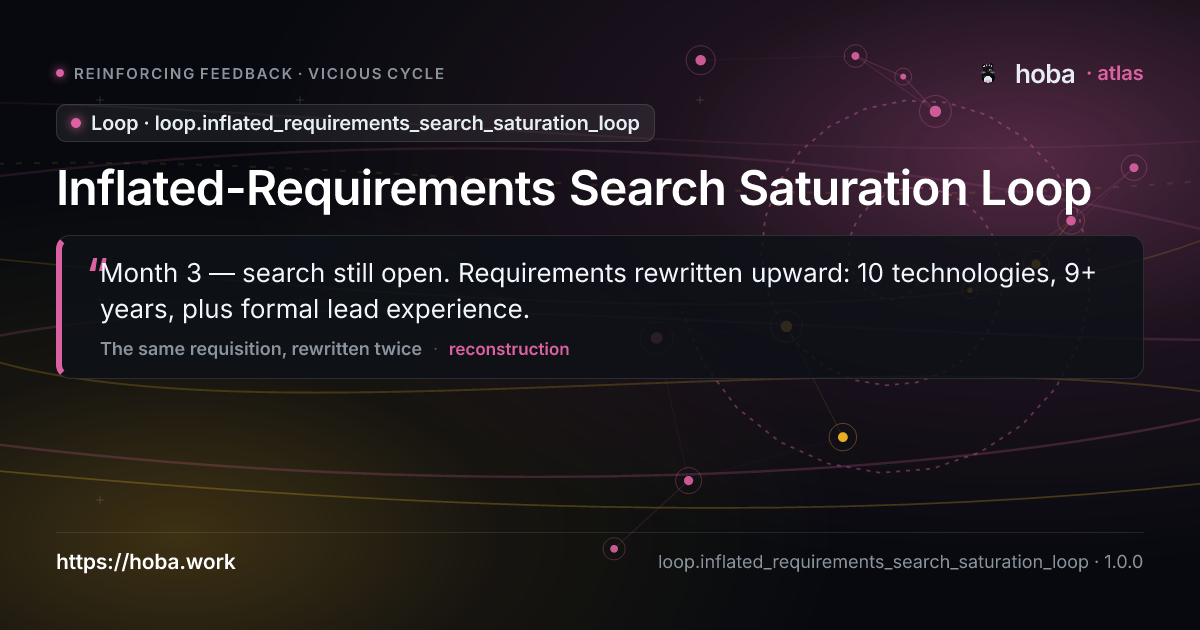
Month 3 — search still open. Requirements rewritten upward: 10 technologies, 9+ years, plus formal lead experience.
Month 6 — search still open. Recruiter reassigned; team now covering the work with overtime.
What to notice: The response to a failed search was a narrower filter. The filter was the reason the search failed, which is the turn that makes this a loop.
- month 3RecruiterDo we really need nine years and Rust for this? The backlog is mostly billing endpoints.
- month 3Hiring managerNobody good has applied in three months. If we lower the bar we will get more of the same.
What to notice: The inference runs backwards: an empty pipeline is read as evidence that the bar is too low. That reading is what tightens the next iteration.
Edges of this causal loop
mech.inflated_requisition_requirements_vs_actual_team_needsamplifiesmech.automated_keyword_qualification_filter
Inflated Requisition Requirements vs Actual Team Needs Automated Keyword / Qualification Filter
mech.automated_keyword_qualification_filteramplifiesmech.mid_process_role_requirement_redefinition
Automated Keyword / Qualification Filter Mid-Process Role Requirement Redefinition
mech.mid_process_role_requirement_redefinitionamplifiesmech.inflated_requisition_requirements_vs_actual_team_needs
Mid-Process Role Requirement Redefinition Inflated Requisition Requirements vs Actual Team Needs
Mechanisms in this loop (3)
- mech.automated_keyword_qualification_filterAutomated Keyword / Qualification FiltercandidateDeterministic filter rejecting applications missing exact acronyms, certifications, or specific years-of-experience thresholds.
- mech.inflated_requisition_requirements_vs_actual_team_needsInflated Requisition Requirements vs Actual Team NeedsintermediaryThe posting lists 10+ named technologies and a Staff-level bar for a role whose actual work is feature delivery.
- mech.mid_process_role_requirement_redefinitionMid-Process Role Requirement RedefinitionnoneThe team changes the stack, the seniority level or the project scope while candidates are mid-process, and the assessments already taken no longer apply.
Interventions proposed to break this loop
- int.auto_close_stale_job_requisitionsAuto-Close Stale Job RequisitionsImplement an automated ATS policy to expire public listings when headcount authorisation lapses or the configured interview-inactivity interval elapses.
- int.requirements_drawn_from_the_team_s_own_backlogRequirements Drawn From the Team's Own BacklogDraft the requisition's requirement list from the last two quarters of the team's actual work: every requirement the screen reads names a task it is required for, and anything without one is published in a separate section that is not screened on.
- int.standardized_late_stage_rejection_feedback_taxonomyStandardized Late-Stage Rejection Feedback TaxonomyProvide candidates reaching technical or panel stages with structured, rubric-based feedback categories rather than generic templates.
Reached without being linked
The relations above are one step. This is what the entry reaches only by walking through them — the shape of it, since the list runs long in a registry this cross-referenced.
- 25
- Observation8Barrier14Mechanism3
From each side
The same entry from inside each position that meets it: what reaches them, what it means from there, and what happens next given what they control.
- What reaches them
- A requisition ageing past the time-to-fill it is measured on, and a requirements list that got longer at the rewrite.
- What it means from there
- The requirements belong to the hiring manager, who is the internal client for this search.
- What happens next
- Raises the question once, posts the revised text, and moves screening capacity to requisitions that can close.
- What reaches them
- A posting with ten required technologies, a nine-year threshold and a lead requirement, republished with a longer list than the version before it.
- What it means from there
- The list is either the bar or a wish, and the posting does not say which; the year thresholds are the part a filter can act on.
- What happens next
- Skips the posting or applies against a list they do not match, and never learns which of the requirements the screen enforced.
ATS vendorNot visible from here
From this position the entry is not visible. That is not a gap in the atlas — it is the finding: the decision is made where nobody in this position can see it.
ClientNot visible from here
From this position the entry is not visible. That is not a gap in the atlas — it is the finding: the decision is made where nobody in this position can see it.
Employer policyNot visible from here
From this position the entry is not visible. That is not a gap in the atlas — it is the finding: the decision is made where nobody in this position can see it.
Public policy and industry standardsNot visible from here
From this position the entry is not visible. That is not a gap in the atlas — it is the finding: the decision is made where nobody in this position can see it.