- What reaches them
- Assignments scoped at a few hours that take double-digit hours each, and rejections returned faster than the work can be read.
- What it means from there
- The hours come out of the same budget as the search itself, so each assignment is a bet placed against the applications not sent that week.
- What happens next
- Sends fewer applications and finishes the assignments already accepted, because the hours in them are already spent.
Take-Home Opportunity-Cost Saturation Loop
Candidates invest heavy hours into unbounded take-home assignments, reducing bandwidth for applications, while reviewers suffer evaluation fatigue.
Loop L-002 Evidence: supported
What it looks like
Composite excerpts, written to be typical rather than copied. No particular message, company or person is quoted here.
Take-home A: 14 hours. Take-home B: 11 hours. Take-home C: 16 hours.
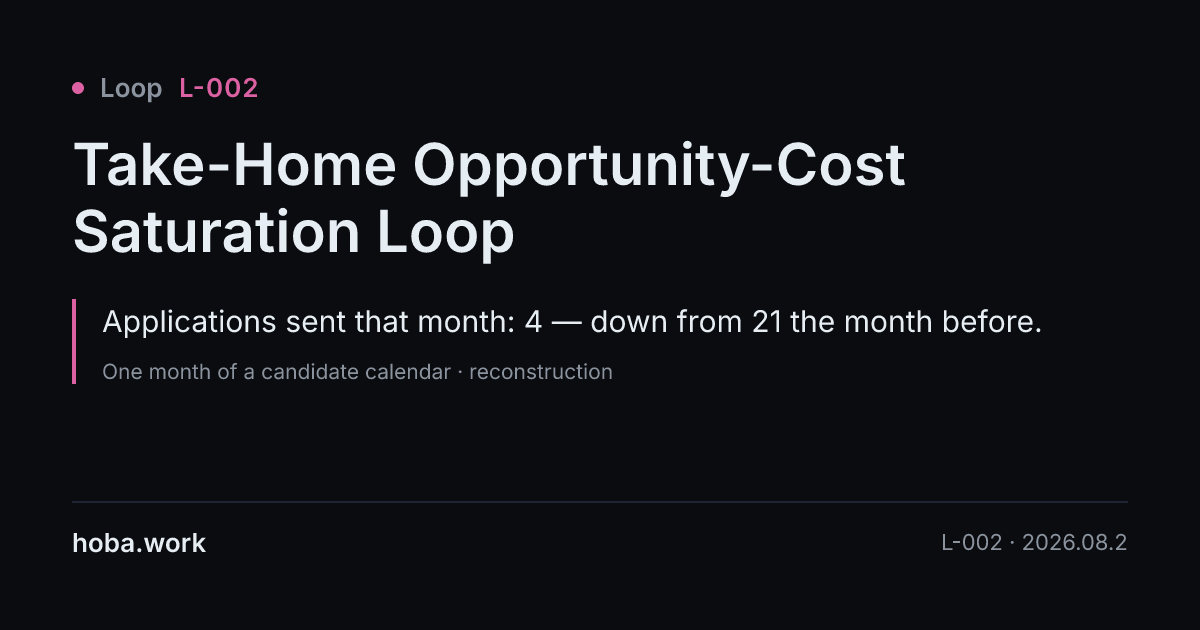
Applications sent that month: 4 — down from 21 the month before.
Outcomes: two rejections after sub-ten-minute reviews, one no response, one still open.
What to notice: The hours are real and they come out of the same budget as the search itself. Fewer applications is not a change in motivation; it is arithmetic.
Submissions in the queue: 19 · Reviewer capacity: 2 hours per week
Median review time per submission: 6 minutes.
Reviewers report the assignments are too large to assess properly, and the scope is set by the same team.
What to notice: Both sides are short of the same thing. Larger assignments do not buy better signal — they buy shallower reads, which is what makes it a loop rather than a trade-off.
Edges of this causal loop
Mechanisms in this loop (2)
- M-012 Interview Resource & Scheduling Saturation intermediary Engineering interviewers are overwhelmed with sprint commitments, leading to calendar fragmentation, rush reviews, or dropped loops.
- M-019 Take-Home Evaluation Fatigue & Asymmetry none Reviewers perform hurried 5-minute scans of complex 15-hour take-home projects, missing subtle architectural patterns and tests.
Interventions proposed to break this loop
From each side
The same entry from inside each position that meets it: what reaches them, what it means from there, and what happens next given what they control.
- What reaches them
- A queue of submissions and interviewer hours that are already committed to the sprint the role exists to relieve.
- What it means from there
- A larger assignment covers more of the job, and a full read of every submission is not available from the hours the team has.
- What happens next
- Keeps the scope, since a smaller assignment would decide less, and the reviews get the minutes left after the team's own delivery.
- What reaches them
- Candidates going quiet between the assignment being sent and the work coming back, and time-to-fill running on the requisition.
- What it means from there
- A stage where the pipeline stalls is a reason to put more people into it, not a reason to remove the stage.
- What happens next
- Sends reminders and reopens sourcing, which puts more submissions into the same review queue.
ATS vendorNot visible from here
From this position the entry is not visible. That is not a gap in the atlas — it is the finding: the decision is made where nobody in this position can see it.
Employer policyNot visible from here
From this position the entry is not visible. That is not a gap in the atlas — it is the finding: the decision is made where nobody in this position can see it.
Public policy and industry standardsNot visible from here
From this position the entry is not visible. That is not a gap in the atlas — it is the finding: the decision is made where nobody in this position can see it.