- What reaches them
- A field on the requisition recording whether an internal availability is live, and a closure code that distinguishes a bench fill from a hire and from a cancellation.
- What it means from there
- The distinction already exists in the staffing system; what is new is that it reaches the outside. A search that closes internally and is reported as a hire understates how often external effort is spent against a seat that was never contestable.
- What happens next
- Adds the closure code, and requires the date the availability appeared to be carried into the notice.
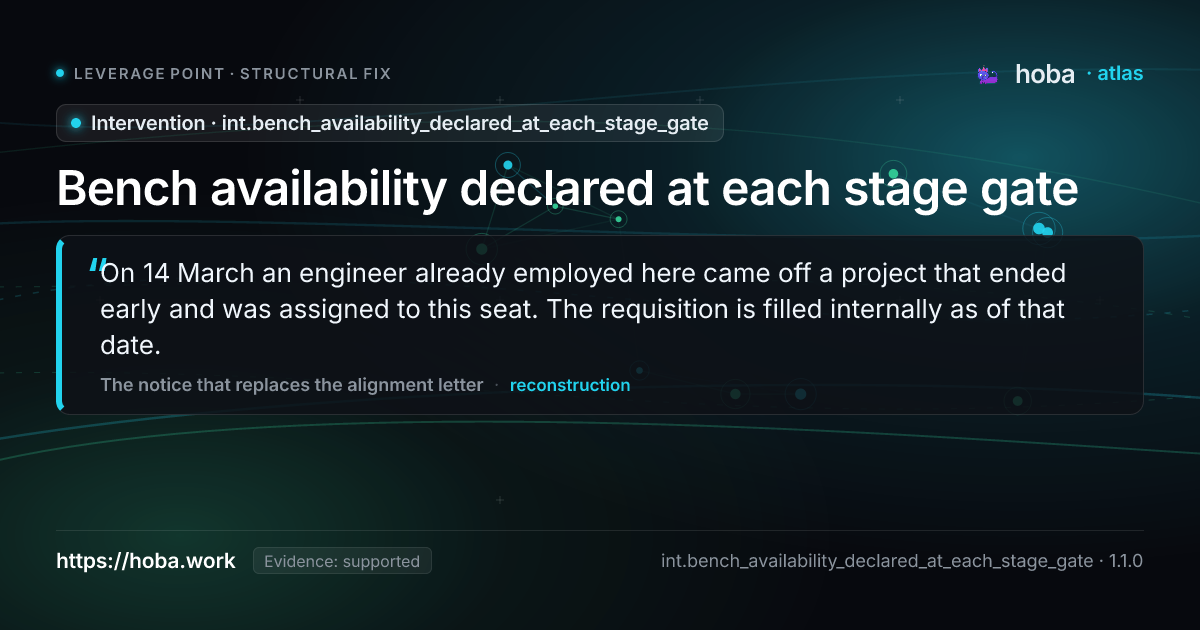
Bench availability declared at each stage gate
At every advance the search states whether an already-employed engineer between projects could still take the seat, and an external candidate closed out by a bench fill is told so, with the date the availability appeared.
Interventionint.bench_availability_declared_at_each_stage_gateActor: employer policyScope: organizationalCost: lowEvidence: supported
What it looks like when this intervention is in place
Composite excerpts, written to be typical rather than copied. No particular message, company or person is quoted here.
Backend engineer, req #5120 — the search is closed and why
On 14 March an engineer already employed here came off a project that ended early and was assigned to this seat. The requisition is filled internally as of that date.
Your panel scored above the bar. Nothing in your assessment is the reason this ended, and the scores are held for 12 months against the next opening at this level.
What to notice: A company will always prefer an engineer it is already paying, and this does not ask it to stop. It asks the date to be named. The letter costs a paragraph and takes away the only thing the candidate would otherwise have to work with: an inference about their own performance drawn from an event that had nothing to do with it.
What this targets
Expected effects
- mech.bench_priority_fill keeps operating — it cannot be removed — but stops being read as a verdict on the candidate
- External effort spent against an internally contestable seat becomes countable, and can be priced
What to measure
bench_fill_closure_ratedated_closure_notice_rate
Reached without being linked
The relations above are one step. This is what the entry reaches only by walking through them — the shape of it, since the list runs long in a registry this cross-referenced.
- 15
- Observation3Barrier12
From each side
The same entry from inside each position that meets it: what reaches them, what it means from there, and what happens next given what they control.
- What reaches them
- The staffing feed showing a bench engineer assigned to the requisition mid-search, and a pipeline that has to be closed out that day.
- What it means from there
- The close-out is not a judgement to be softened into alignment language — the reason is a date, and writing the date is faster than composing around it.
- What happens next
- Sends the dated notice to everyone still in flight, and records the assessment scores against the next opening rather than discarding them.
- What reaches them
- A dated reason: a seat filled from inside on a day that can be checked against the day the process went quiet.
- What it means from there
- The outcome was decided by an event in someone else's project schedule. There is no performance signal in it to act on, and no version of the interview that would have changed it.
- What happens next
- Stops re-reading the panel for a fault that was not there, and keeps the standing score rather than starting over.
ATS vendorNot visible from here
From this position the entry is not visible. That is not a gap in the atlas — it is the finding: the decision is made where nobody in this position can see it.
ClientNot visible from here
From this position the entry is not visible. That is not a gap in the atlas — it is the finding: the decision is made where nobody in this position can see it.
Hiring managerNot visible from here
From this position the entry is not visible. That is not a gap in the atlas — it is the finding: the decision is made where nobody in this position can see it.
Public policy and industry standardsNot visible from here
From this position the entry is not visible. That is not a gap in the atlas — it is the finding: the decision is made where nobody in this position can see it.