- What reaches them
- A feature column in the training set, and the ranked order that shifts for every customer once it is removed.
- What it means from there
- The removal itself is one line in a feature list and a re-scoring run; the effect it is made for happens outside the platform, where there is no telemetry.
- What happens next
- Ships the change with the model card updated, and carries the support load from customers whose thresholds were tuned against the old distribution.
Remove Career Gap Feature from Automated Ranking Models
Disable employment duration gap penalties in recruitment AI algorithms and screening models.
Intervention I-004 Actor: ATS vendor Scope: ecosystem Cost: low Evidence: supported
On the canonical path
Machine work stays mechanical — Automation deduplicates, extracts and orders. It does not decide. Where a rule does end an application, the rule is stated and it is one a person would defend out loud.
This entry is one of the things that holds that commitment up.
What it looks like when this intervention is in place
Composite excerpts, written to be typical rather than copied. No particular message, company or person is quoted here.
- Skills match: 91/100 · Domain match: 88/100
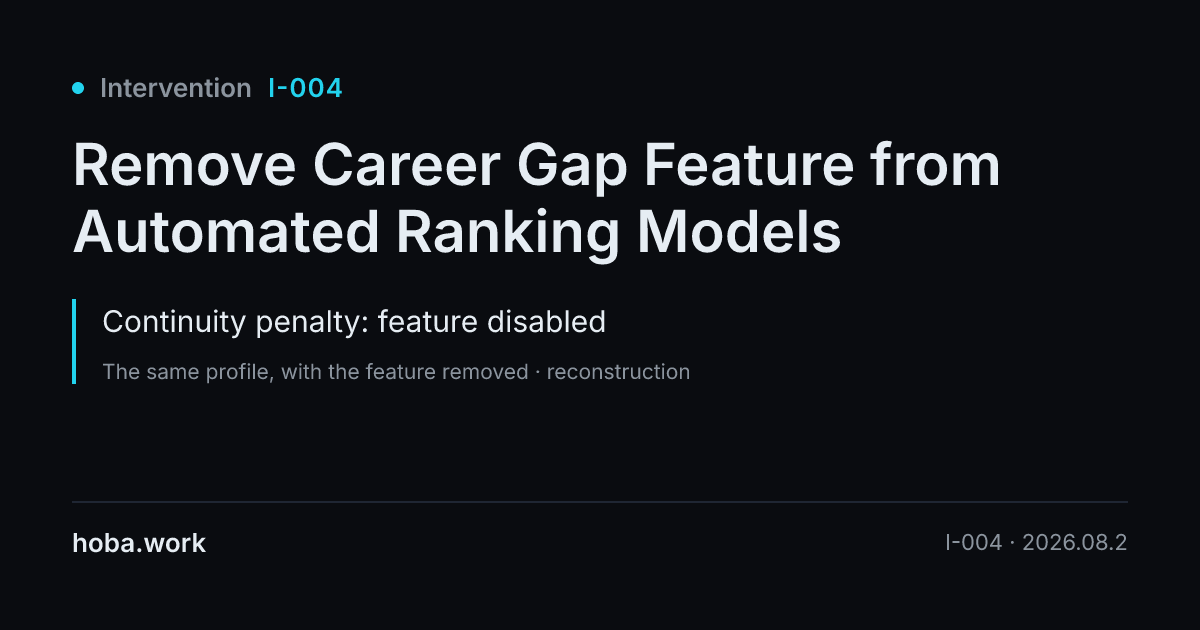
- Continuity penalty: feature disabled
- Final rank: 89/100 — advanced to recruiter queue
- Model card updated: employment_gap removed from feature set, 14 March.
What to notice: The arithmetic is the whole intervention. The same person, the same work, above the threshold instead of below it.
What this targets
Expected effects
- Break algorithmic unemployment penalty loop
- Broaden candidate pool to include skilled returning talent
What to measure
gap_candidate_screen_ratelong_term_placement_success
From each side
The same entry from inside each position that meets it: what reaches them, what it means from there, and what happens next given what they control.
- What reaches them
- Profiles in the queue that the previous ranking placed below the review threshold.
- What it means from there
- The queue is longer and the screening capacity is the same; ranking decides reading order, not how many get read.
- What happens next
- Reads down the new order until capacity runs out, and the profiles below that line stay unread — for a reason that is no longer the gap.
Public policy and industry standards
- What reaches them
- A published model card naming the feature that was removed, in a market where the same feature ships enabled by default elsewhere.
- What it means from there
- One vendor removing it changes one vendor's ranking; what would hold it across the market is a rule about what an automated screen may read at all.
- What happens next
- Writes the requirement against what a vendor must publish and explain; what a customer switches on inside a configuration screen sits outside what any disclosure rule inspects.
CandidateNot visible from here
From this position the entry is not visible. That is not a gap in the atlas — it is the finding: the decision is made where nobody in this position can see it.
Employer policyNot visible from here
From this position the entry is not visible. That is not a gap in the atlas — it is the finding: the decision is made where nobody in this position can see it.
Hiring managerNot visible from here
From this position the entry is not visible. That is not a gap in the atlas — it is the finding: the decision is made where nobody in this position can see it.