- What reaches them
- A posting draft with a band in it, and the same band readable by everyone already employed at that level.
- What it means from there
- Publishing fixes a number that was previously settled per candidate, and makes internal pay spread visible in a document anyone can open.
- What happens next
- Requires the band to be verified by finance before the posting goes live, which adds an approval step to publishing a role.
Upfront Compensation Band Disclosure
Publish verified salary and equity bands directly in job descriptions or disclose them prior to scheduling technical interview rounds.
Intervention I-002 Actor: employer policy Scope: industry Cost: low Evidence: supported
On the canonical path
Published with its terms on the page — The posting states the compensation band, the location rules, the stages the process has and roughly how long each takes. It comes down when the search ends.
Terms compared before anyone spends time — Band, level, location, notice period and start date are put side by side in the first conversation, before any assessment is scheduled. Either side can stop here at no cost to the other.
The level meets the band that was published — The level follows from the evidence the panel gathered, and the band was public from the first day. Reconciling them is arithmetic, not a negotiation about whether the band exists.
This entry is one of the things that holds that commitment up.
What it looks like when this intervention is in place
Composite excerpts, written to be typical rather than copied. No particular message, company or person is quoted here.
Title: Senior Backend Engineer · Payments
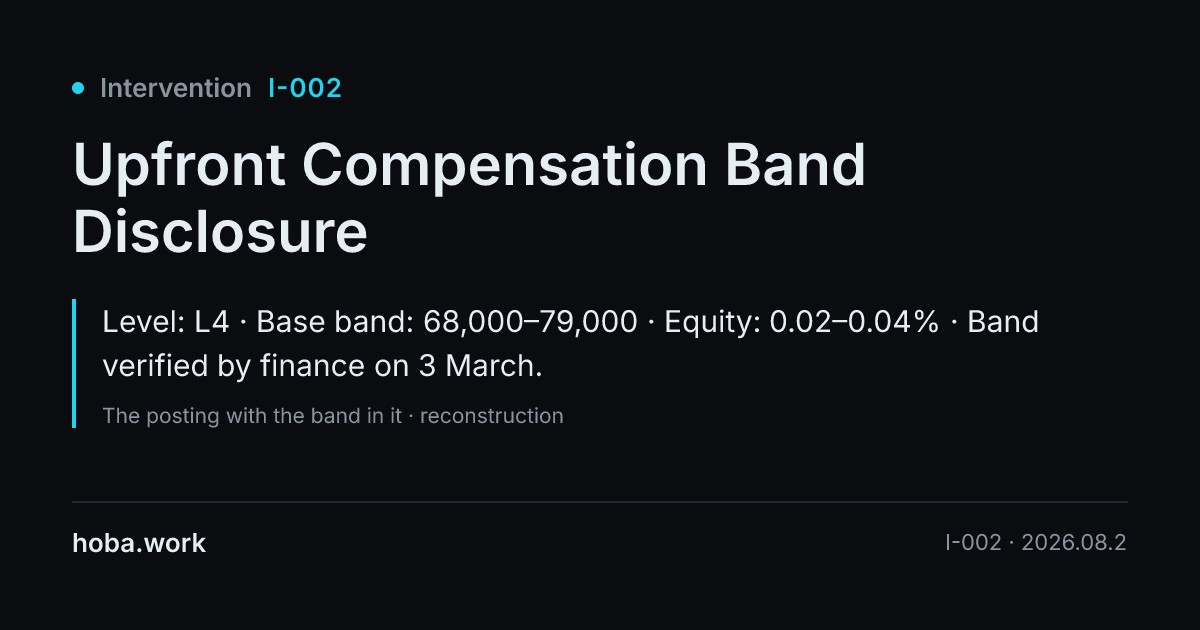
Level: L4 · Base band: 68,000–79,000 · Equity: 0.02–0.04% · Band verified by finance on 3 March.
We will not ask for your expectations before showing you this number.
If your expectation sits above the band, tell us at the screen and we will say honestly whether the level can move.
What to notice: Every branch of the compensation bind needs the candidate to speak first. Publishing the number removes the asymmetry the bind is built on.
What this targets
Expected effects
- Eliminate late-stage compensation mismatch dropouts
- Reduce time wasted on mismatched leveling conversations
What to measure
late_stage_compensation_drop_ratecandidate_pipeline_satisfaction
From each side
The same entry from inside each position that meets it: what reaches them, what it means from there, and what happens next given what they control.
- What reaches them
- The band as a published line in the requisition, available before the screening call rather than after the panel.
- What it means from there
- The expectation question is no longer the filter: a candidate above the band says so at the screen, where the process has cost nobody five rounds.
- What happens next
- Opens the screen with the number, and routes a mismatch into the levelling question instead of carrying it to the offer stage.
- What reaches them
- The band and the level in the posting, dated and attributed, before any unpaid hours are committed.
- What it means from there
- The one number the whole process is arranged around is available before entering it, so applying becomes a decision about a known range.
- What happens next
- Applies or does not, and where the expectation sits above the band, raises it at the screen instead of at the offer.
Public policy and industry standards
- What reaches them
- Postings carrying a band in covered jurisdictions, and postings carrying one elsewhere because the practice spread.
- What it means from there
- Compliance is checkable against the text of the posting; the level a candidate is actually assessed at sits outside what any current disclosure rule reaches.
- What happens next
- Sets the requirement on the posting, the one artefact an inspection can check; the levelling decision has no comparable artefact for a rule to attach to.
ATS vendorNot visible from here
From this position the entry is not visible. That is not a gap in the atlas — it is the finding: the decision is made where nobody in this position can see it.
Hiring managerNot visible from here
From this position the entry is not visible. That is not a gap in the atlas — it is the finding: the decision is made where nobody in this position can see it.