- What reaches them
- The panel's score sheets and, in the split case, one dissent with a comment. What that panelist saw arrives second-hand.
- What it means from there
- Under a unanimity threshold, one no-hire and three no-hires read the same. The dissent reads as a risk that would be carried alone.
- What happens next
- Overrides or closes. The override carries their signature, and so would the hire it produces.
Team & Cross-Functional Panel
Multi-interviewer round assessing collaborative problem solving, code review etiquette, cross-functional communication, and cultural norms.
Barrier B-008 Stage: Team Step in the funnel: #10 Evidence: established
On the canonical path
One panel, one question each, one decision rule — Every interviewer knows what they are measuring and that nobody else is measuring it. The rule that turns their scores into a decision is agreed before the first conversation, and no round is added after the process has started.
This entry is one of the ways that commitment stops being kept.
What it looks like
Composite excerpts, written to be typical rather than copied. No particular message, company or person is quoted here.
Panelist 1 — collaboration 4, communication 4: hire
Panelist 2 — collaboration 4, communication 3: hire
Panelist 3 — collaboration 3, communication 2: no hire
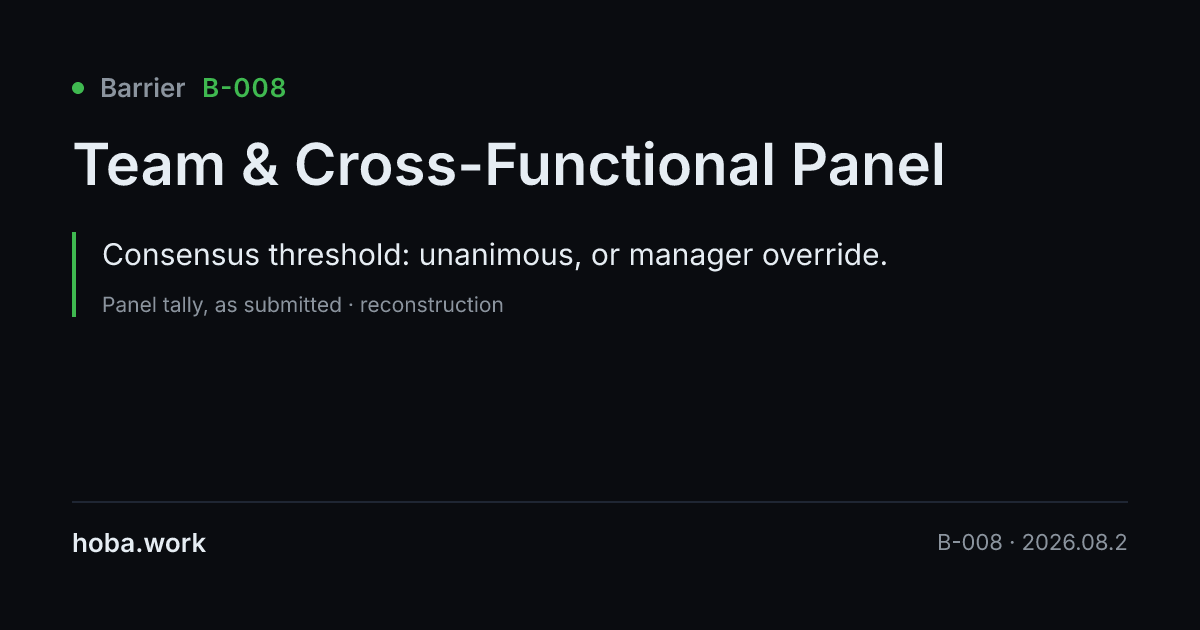
Consensus threshold: unanimous, or manager override.
Outcome: not aligned.
What to notice: The gate is not an average, it is a veto rule. One dissent and a unanimity requirement produce the same result as three dissents.
Barriers before this one
Barriers after this one
Mechanisms operating at this barrier (7)
- M-002 Stronger Competing Candidate in Final Cohort none Candidate cleared all passing bars, but another applicant in the same pipeline demonstrated superior domain overlap or lower onboarding overhead.
- M-007 Headcount Freeze or Budget Cancellation none Executive leadership or finance halts all new hires across division due to macroeconomic factors or revenue shifts mid-interview process.
- M-010 Hidden Evaluation Rubric or Undisclosed Priority intermediary The interview team grades candidate against specific undisclosed architectural dogmas, internal frameworks, or unwritten biases.
- M-012 Interview Resource & Scheduling Saturation intermediary Engineering interviewers are overwhelmed with sprint commitments, leading to calendar fragmentation, rush reviews, or dropped loops.
- M-013 Mid-Process Role Requirement Redefinition none Team changes tech stack, seniority requirements, or project scope mid-funnel, invalidating previous interview assessments.
- M-015 Communication or Working Style Friction candidate Candidate demonstrated abrasive tone, defensive reactions to critique, or inability to listen during collaborative interview problem solving.
- M-022 Hiring Manager Consensus Impasse none The interview panel splits 50/50 without an executive tiebreaker, defaulting conservatively to a "no-hire" decision.
Interventions targeting this barrier
From each side
The same entry from inside each position that meets it: what reaches them, what it means from there, and what happens next given what they control.
- What reaches them
- A sequence of separate conversations, each with a person whose weight in the decision is not stated. Then one outcome.
- What it means from there
- The round reads as an average of impressions, and the wording of the decline does not distinguish a split panel from a unanimous one.
- What happens next
- Cannot tell which conversation the decision turned on, so records who was on the panel and what each of them asked — the only part of this gate still available afterwards.
- What reaches them
- The threshold as a configured rule, and the outcome it produced. The individual sheets stay with the team.
- What it means from there
- A unanimity requirement reads as consistency across hires and as a defensible record for each one.
- What happens next
- Keeps the threshold uniform across teams. The hours a re-run of the loop consumes are not a line in the cycle this layer reports on.
ATS vendorNot visible from here
From this position the entry is not visible. That is not a gap in the atlas — it is the finding: the decision is made where nobody in this position can see it.
Public policy and industry standardsNot visible from here
From this position the entry is not visible. That is not a gap in the atlas — it is the finding: the decision is made where nobody in this position can see it.
RecruiterNot visible from here
From this position the entry is not visible. That is not a gap in the atlas — it is the finding: the decision is made where nobody in this position can see it.