- What reaches them
- A queue of inbound records, a screening capacity smaller than it, and an outbound list running against the same requisition.
- What it means from there
- Position and source are part of the outcome here. Time-to-fill is measured; time-to-clarity is not.
- What happens next
- Works the outbound list first and skims inbound in queue order. The records below where the day ends stay unreviewed.
Inbound Screening & Triage
Recruiter or sourcing coordinator manual review of parsed inbound applications vs active outbound talent pipelines.
Barrier B-003 Stage: Screening Step in the funnel: #5 Evidence: established
On the canonical path
Read by a person, inside the stated window — Every application that clears the mechanical stage is read by someone, and read before the window the posting promised runs out.
This entry is one of the ways that commitment stops being kept.
What made this ordinary
A fixed number of seats · 2024–2026 — The conditions that made hiring expensive were reversed; the number of positions was not. The contraction now runs through the hiring channel rather than the separation channel, which is why it is competition for a fixed and shrinking number of seats rather than a shortage of qualified people.
What it looks like
Composite excerpts, written to be typical rather than copied. No particular message, company or person is quoted here.
Source: inbound. Queue position 211 of 640.
Skim: backend, payments, right seniority band. No red flags.
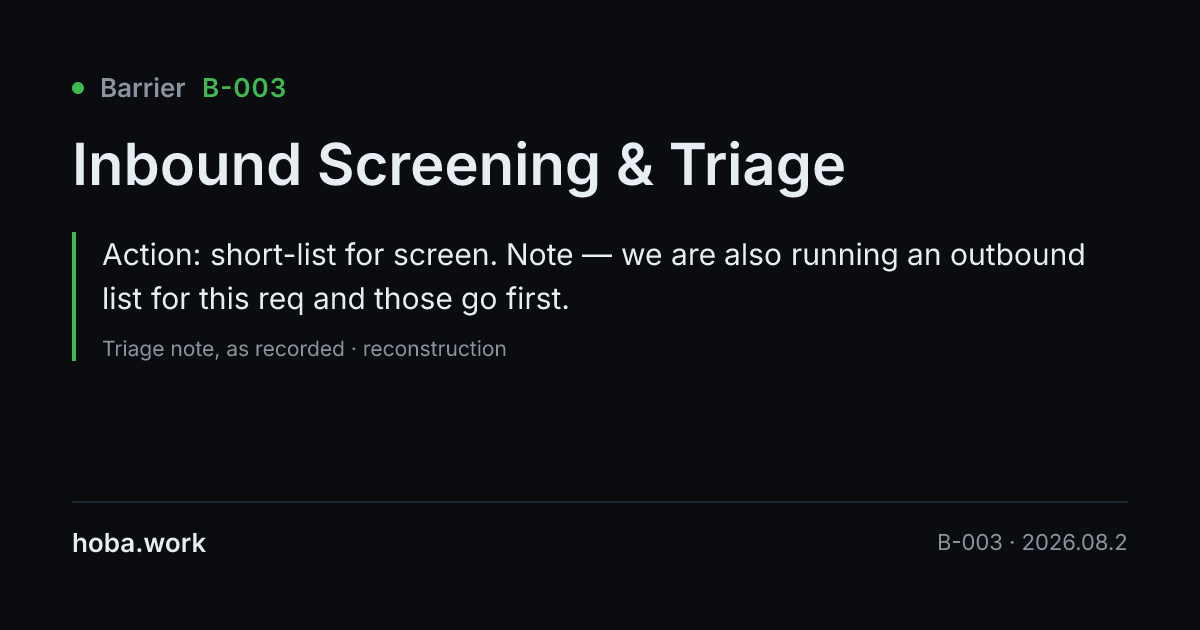
Action: short-list for screen. Note — we are also running an outbound list for this req and those go first.
What to notice: Inbound and outbound applications compete at this gate, and they do not arrive on equal footing. Position in the queue is part of the outcome.
Barriers before this one
Barriers after this one
Mechanisms operating at this barrier (8)
- M-005 Pre-Selected Internal Candidate none Requisition was publicly advertised to satisfy corporate policy or legal compliance while an internal employee was already earmarked for the role.
- M-006 Stale or Orphaned Job Requisition none Job posting remains active on careers page and aggregator portals despite the team having ceased active hiring or closed headcount.
- M-009 Recruiter Volume & Quota Incentive Distortion intermediary Recruiters optimize for pipeline velocity and superficial pattern-matching due to overwhelming applicant volume (500+ per req).
- M-011 Employment Gap Downranking Bias none Automated ranking algorithms or human screeners discount candidates with recent career breaks regardless of verified project history.
- M-016 Speculative Sourcing / Talent Pooling Without Opening none Recruiters proactively gather candidate pools for future anticipated headcount that is not yet authorized or funded.
- M-017 Experience-Age Grading Mismatch none Candidate with 10+ years applied for mid/senior role, triggering fears of boredom, rapid churn, or salary dissatisfaction.
- M-020 Automated Application Expiration Timeout none ATS configuration automatically issues bulk rejections to all pending unreviewed applications after 45 or 60 days.
- M-023 Portfolio / Work Artifact Misinterpretation candidate Screeners overlook candidate role architecture due to non-standard repository layout or unindexed open-source contributions.
From each side
The same entry from inside each position that meets it: what reaches them, what it means from there, and what happens next given what they control.
- What reaches them
- The same status as on the day of applying, and a gap that lengthens.
- What it means from there
- Nothing here separates a record that has not been reached from one that was read and passed over.
- What happens next
- Sends a follow-up, then treats the process as closed while it remains formally open.
- What reaches them
- Requisition-level figures: applications received, time-to-fill, cost per hire. The queue and the hours held in it are not among them.
- What it means from there
- Volume received reads as reach. The figures show arrivals, not what happened to them.
- What happens next
- Keeps the external posting requirement and sets the recruiting headcount that fixes review capacity, on a cycle measured in quarters.
ATS vendorNot visible from here
From this position the entry is not visible. That is not a gap in the atlas — it is the finding: the decision is made where nobody in this position can see it.
Hiring managerNot visible from here
From this position the entry is not visible. That is not a gap in the atlas — it is the finding: the decision is made where nobody in this position can see it.
Public policy and industry standardsNot visible from here
From this position the entry is not visible. That is not a gap in the atlas — it is the finding: the decision is made where nobody in this position can see it.