- What reaches them
- A shortfall named in terms of something missing, against a submission that contains it — at a path that was given, in a file that opens.
- What it means from there
- Absent and insufficient are different claims. A reader who opened the work and judged it thin would say thin; the word missing describes a surface, and the surface may not be the one the work is on.
- What happens next
- Checks what the given path actually resolves to for someone with no context: default branch, first screen, whether the work sits under another organisation's account.
Feedback naming as absent something the submitted work contains
The stated shortfall is the absence of work that is present in what the candidate submitted, at the path they gave.
Observation A-019 ScreeningTechnical Evidence: hypothesis Status: active
What it looks like
Composite excerpts, written to be typical rather than copied. No particular message, company or person is quoted here.
Subject: Following your application
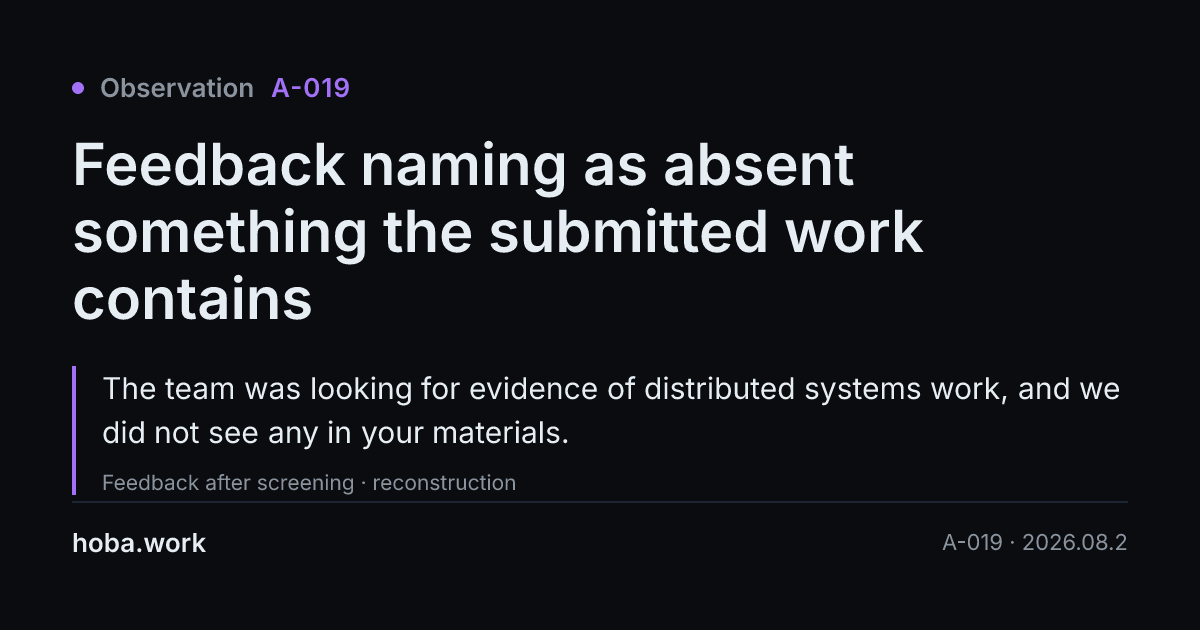
The team was looking for evidence of distributed systems work, and we did not see any in your materials.
We would encourage you to apply again once you have that experience.
The submitted index named three services and the path to each.
What to notice: Two sentences that cannot both hold. Either the work is absent or it was not opened — and only the second is consistent with a submission that names it.
How to read this observation
An observation is something a candidate received or lived through. It is a consequence of the mechanisms underneath, not proof that any one of them was at work.
Diagnostic probes
- Probe PROBE-A-019-1 Cost: low
Action: Open the submitted path in a private window with no session, and note what the first screen shows before any navigation.
Expected observation: Establishes what a reader with no context and no time actually lands on.
Compatible mechanisms (1)
Open the analysis walkthrough →What this observation does NOT establish
- Does not establish that the work was never opened, only that the claim and the submission disagree.
- Does not establish that the work would have met the bar had it been read.
Reached without being linked
The relations above are one step. This is what the entry reaches only by walking through them — the shape of it, since the list runs long in a registry this cross-referenced.
- 2
- Intervention2
From each side
The same entry from inside each position that meets it: what reaches them, what it means from there, and what happens next given what they control.
- What reaches them
- A profile and a link. Opening the link leads to a listing whose relevance is not decidable without reading code.
- What it means from there
- The submission is a claim to be passed on, not one to be assessed here. What can be checked at this desk is whether the requirement's keywords appear.
- What happens next
- Records against the requirement using what the profile states, and forwards the link unopened to whoever can read it.
- What reaches them
- A repository opened for a few minutes between meetings, landing on whatever the default branch shows first.
- What it means from there
- What the first screen shows stands for the whole, because there is no time to establish that it does not. A layout that buries the work reads the same as an absence of it.
- What happens next
- Writes the note against what was seen, in the vocabulary of what was expected to be there.
ATS vendorNot visible from here
From this position the entry is not visible. That is not a gap in the atlas — it is the finding: the decision is made where nobody in this position can see it.
Employer policyNot visible from here
From this position the entry is not visible. That is not a gap in the atlas — it is the finding: the decision is made where nobody in this position can see it.
Public policy and industry standardsNot visible from here
From this position the entry is not visible. That is not a gap in the atlas — it is the finding: the decision is made where nobody in this position can see it.