- What reaches them
- A reason that can be checked against the posting: a country, a set of hours, a permit. Unlike most stated reasons, this one refers to a fact rather than a judgement.
- What it means from there
- The ground named is verifiable, which is unusual. Whether it was the operative ground, or the one that could be written down without commenting on the candidate, is not settled by the message.
- What happens next
- Compares the ground against what the posting stated when it was applied to, using a saved copy, because a posting can be edited after the fact.
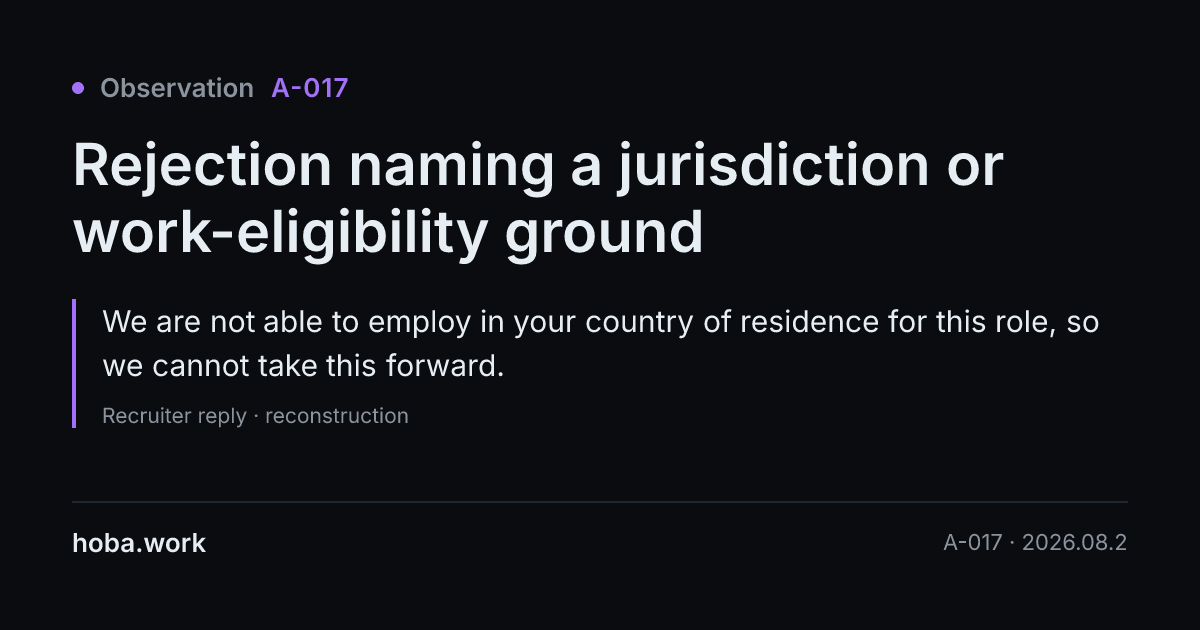
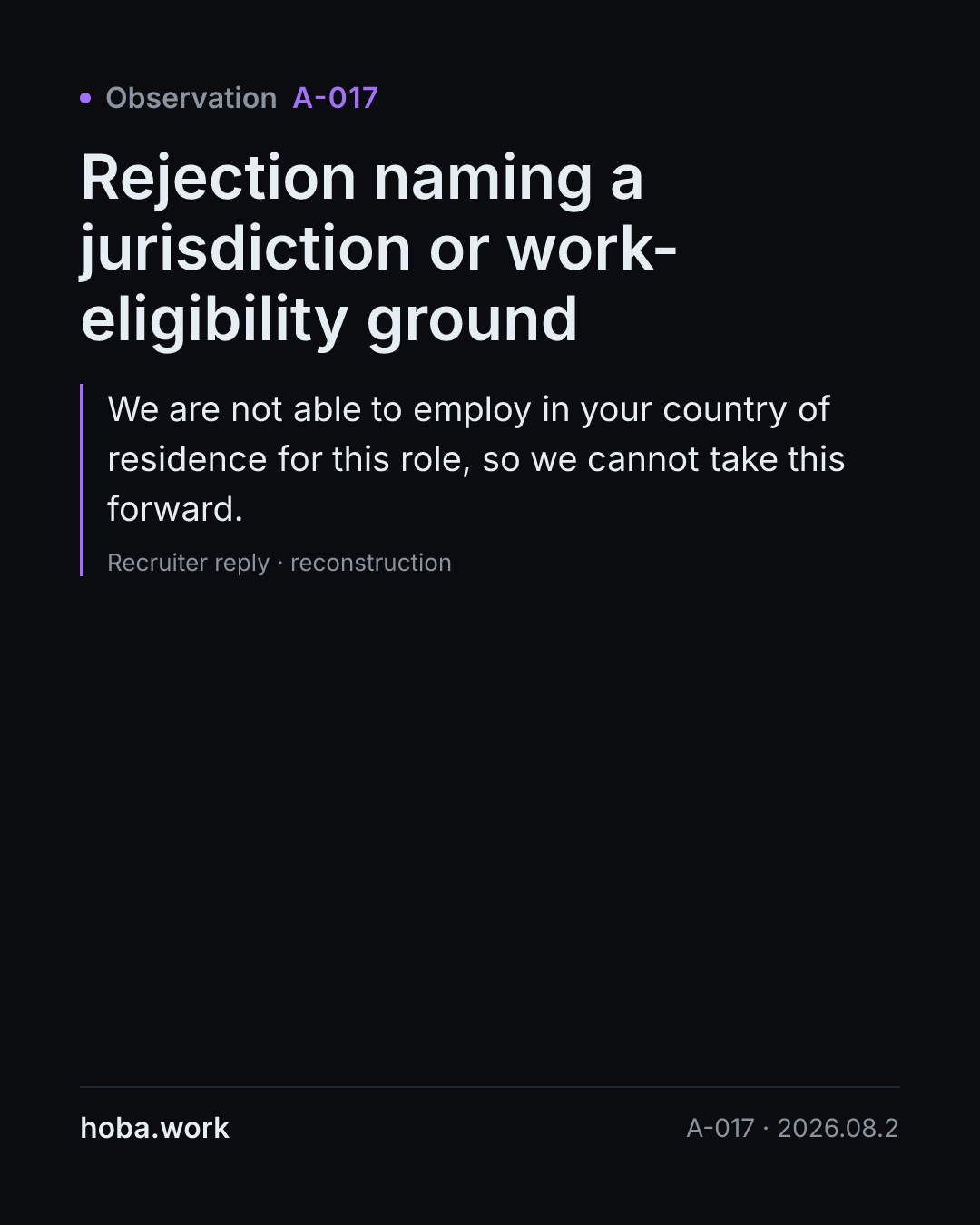
Rejection naming a jurisdiction or work-eligibility ground
The stated reason is where the candidate lives, the hours they can cover, or the right to be employed there — not anything about the work.
Observation A-017 IntakeRecruiter Evidence: hypothesis Status: active
What it looks like
Composite excerpts, written to be typical rather than copied. No particular message, company or person is quoted here.
Subject: Re: your application
Thanks for your time on the call earlier this week.
We are not able to employ in your country of residence for this role, so we cannot take this forward.
If that changes on your side, do let us know.
What to notice: The ground is checkable against a document, which almost no other stated reason is. That makes it worth checking — and checkable is not the same as operative.
How to read this observation
An observation is something a candidate received or lived through. It is a consequence of the mechanisms underneath, not proof that any one of them was at work.
Diagnostic probes
- Probe PROBE-A-017-1 Cost: low
Action: Compare the ground named in the message against the copy of the posting as it stood on the day of application.
Expected observation: Establishes whether the ground was stated up front or introduced afterwards.
Compatible mechanisms (1)
Open the analysis walkthrough →What this observation does NOT establish
- Does not establish that no route to employment existed, only that none was used here.
- Does not establish that the constraint was the first ground on which the application was set aside.
From each side
The same entry from inside each position that meets it: what reaches them, what it means from there, and what happens next given what they control.
- What reaches them
- A candidate the team would take and a hiring location list that does not include where they are.
- What it means from there
- This is the one closing reason that is fully outside the candidate and fully inside a document. It can be stated without hedging.
- What happens next
- Names the ground plainly, because doing so is both accurate and easier than a template that would invite a follow-up.
- What reaches them
- A list of jurisdictions in which a contract can be issued, set by which entities and payroll providers exist, and reviewed on a slower cycle than any single search.
- What it means from there
- The list is a constraint on the search, not an assessment within it. Roles are published against it, and exceptions cost more than a single hire usually justifies.
- What happens next
- Holds the list, and grants exceptions through a route that runs on a different calendar from the requisition.
ATS vendorNot visible from here
From this position the entry is not visible. That is not a gap in the atlas — it is the finding: the decision is made where nobody in this position can see it.
Hiring managerNot visible from here
From this position the entry is not visible. That is not a gap in the atlas — it is the finding: the decision is made where nobody in this position can see it.
Public policy and industry standardsNot visible from here
From this position the entry is not visible. That is not a gap in the atlas — it is the finding: the decision is made where nobody in this position can see it.