- What reaches them
- A band stated in the posting and again at the screen, a lower band stated in week five, and the posting still showing the first figure.
- What it means from there
- An answer that applies to everyone at the grade describes a policy; an answer specific to this candidate would describe an assessment. The reply given was the first.
- What happens next
- Records the original band, the date it was stated and who stated it, and asks whether the revision is to the level or to this offer.
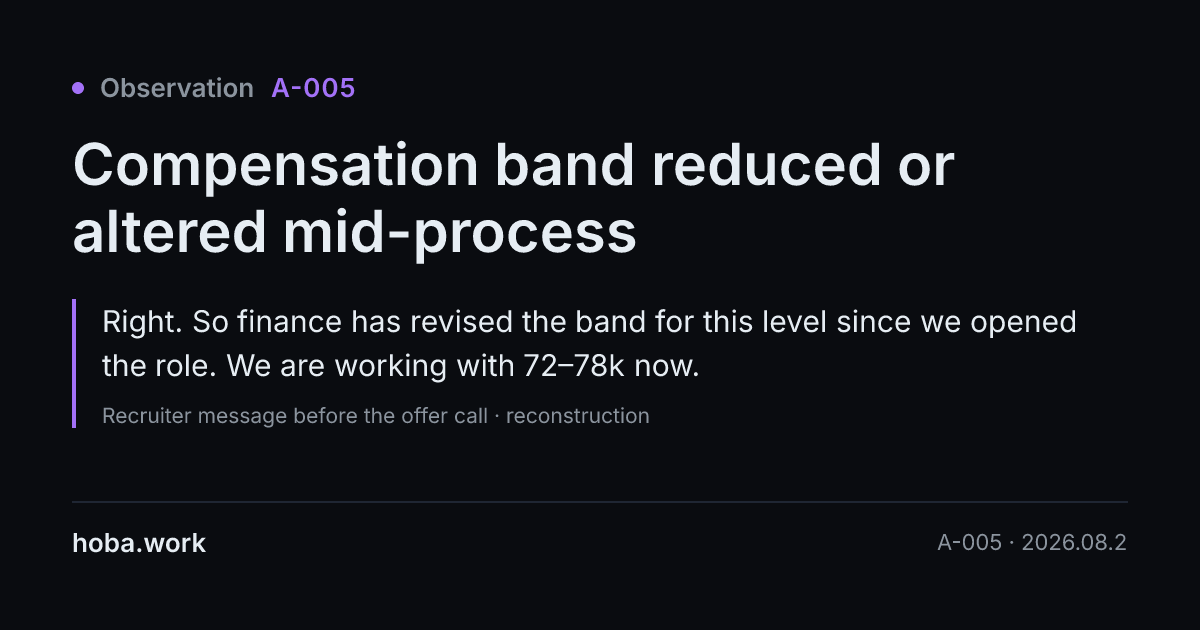
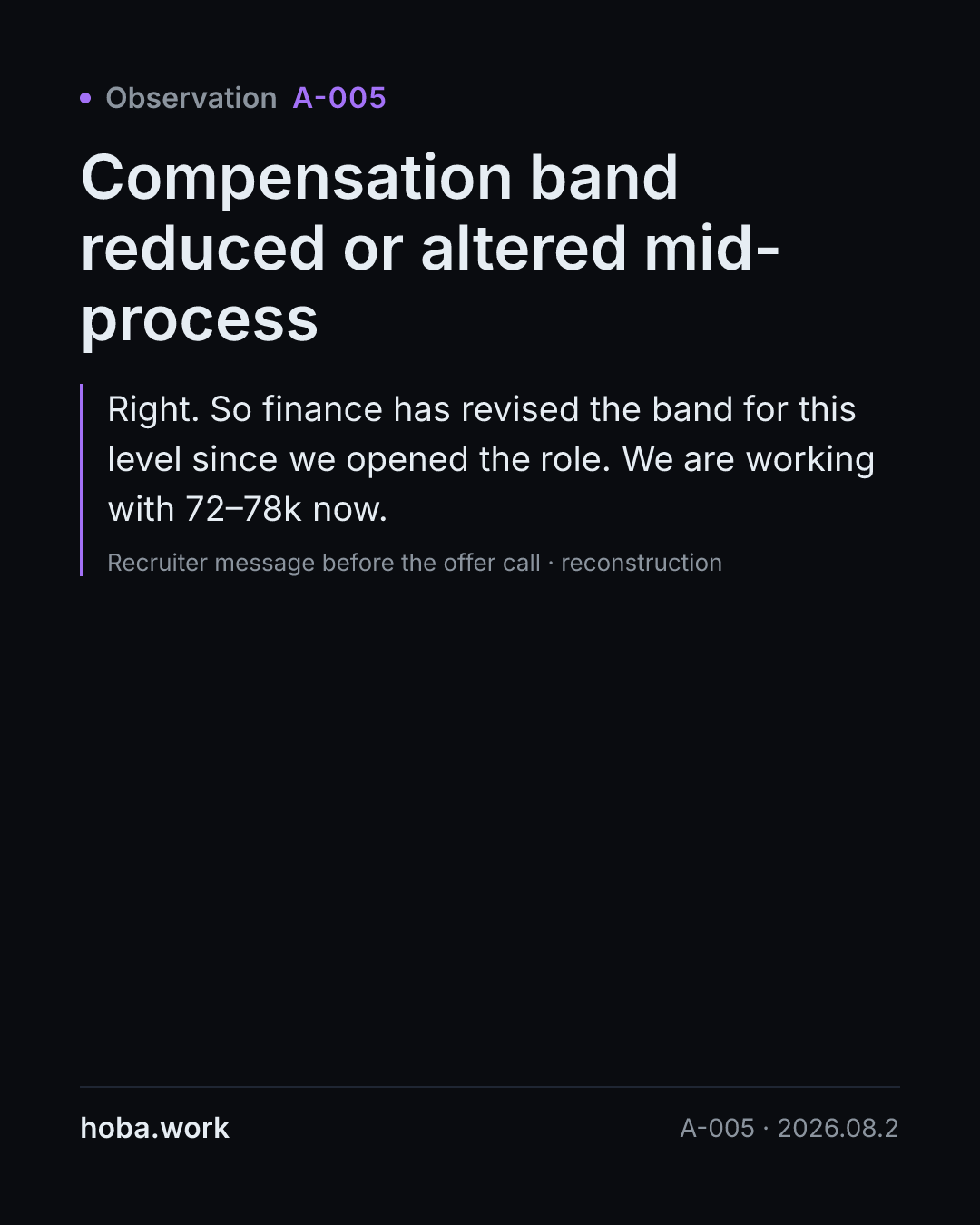
Compensation band reduced or altered mid-process
Offered or discussed compensation band is revised downward from previously agreed or advertised range.
Observation A-005 RecruiterCompensationOffer Evidence: supported Status: active
What it looks like
Composite excerpts, written to be typical rather than copied. No particular message, company or person is quoted here.
- week 5 Recruiter Quick heads-up before we talk numbers tomorrow — where did we land on expectations?
- week 5 Candidate Same as the range in the posting and what we agreed at the screen: 85–95k.
- week 5 Recruiter Right. So finance has revised the band for this level since we opened the role. We are working with 72–78k now.
What to notice: The number moved after the candidate had already spent the process. Note the date the original band was stated and by whom.
- 06:12 Candidate Was the change specific to me, or to the level?
- 06:19 Recruiter To the level. Everyone coming in at this grade this quarter is on the new band.
- 06:31 Candidate And the posting still shows the old range?
- 06:35 Recruiter It does. I will get that updated.
What to notice: An answer that generalises to the whole grade describes a policy. An answer that is specific to you would describe an assessment. They are different mechanisms.
How to read this observation
An observation is something a candidate received or lived through. It is a consequence of the mechanisms underneath, not proof that any one of them was at work.
Diagnostic probes
- Probe PROBE-A-005-1 Cost: medium
Action: Request clarification on whether the revised band reflects a lower leveling grade or a company-wide budget adjustment.
Expected observation: Separates leveling evaluation outcome from company financial constraints.
Compatible mechanisms (1)
Open the analysis walkthrough →What this observation does NOT establish
- Does not prove intentional bait-and-switch malice unless verified by company policy evidence.
Appears in these contradiction patterns
From each side
The same entry from inside each position that meets it: what reaches them, what it means from there, and what happens next given what they control.
- What reaches them
- A revised grid for the level, arriving after the role opened, and a candidate holding the figure stated at the screen.
- What it means from there
- The number changed above the recruiter's position; the earlier figure is the one the candidate is holding going into the offer call.
- What happens next
- States the current band and where it came from, and puts the posting correction in as a request, because the band itself is set a level above this function.
- What reaches them
- A levelling grid and a band per grade, revised on the cycle at which compensation is reviewed.
- What it means from there
- A band set at the grade applies to everyone entering at that grade, which is what makes the hires consistent with one another.
- What happens next
- Revises the grid and applies it from the date of the revision. Processes already running against the previous figure are not rows in that decision.
Public policy and industry standards
- What reaches them
- Postings covered by a disclosure rule carry a range. A revision made mid-process reaches this layer only if the posting is checked against the offer.
- What it means from there
- The published range is a measurable object. The grade a candidate is assessed at, and the date a band was revised, are not covered by the same rule.
- What happens next
- Writes to what is enforceable: the presence of a range in the posting, and not the levelling decision that determines which range applies.
ATS vendorNot visible from here
From this position the entry is not visible. That is not a gap in the atlas — it is the finding: the decision is made where nobody in this position can see it.
Hiring managerNot visible from here
From this position the entry is not visible. That is not a gap in the atlas — it is the finding: the decision is made where nobody in this position can see it.