- What reaches them
- A message sent at 03:14 with no sentence specific to this candidate, this role or this conversation, and a follow-up that returns the same wording.
- What it means from there
- The text is the standard wording for this outcome. Which requirement was the gap is not stated in it, and asking returned the template again.
- What happens next
- Records the date and the exact wording, and compares the CV phrasing against the requirement phrases as published, since the message names no gap to work from.
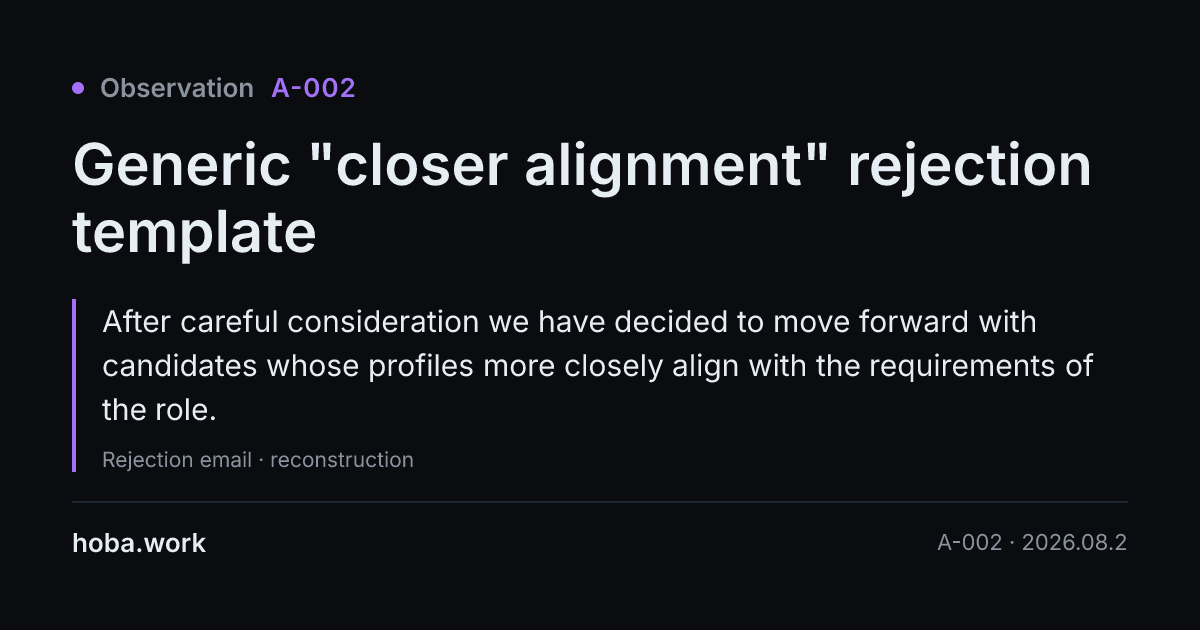
Generic "closer alignment" rejection template
Standard automated email stating the team decided to proceed with candidates whose profiles more closely match role requirements.
Observation A-002 ScreeningRecruiterTechnical Evidence: supported Status: active
On the canonical path
Declined, with a reason that can be acted on — Not every candidate is hired, and a decline is not a deviation. What makes it part of this path is that it arrives, it names the stage it happened at and the criterion that decided it, and it says whether applying again is worth anything.
This entry is one of the ways that commitment stops being kept.
What it looks like
Composite excerpts, written to be typical rather than copied. No particular message, company or person is quoted here.
Subject: Update on your application
Thank you for your interest in our company and for the time you invested in the process.
After careful consideration we have decided to move forward with candidates whose profiles more closely align with the requirements of the role.
We wish you the best in your search and encourage you to apply for future openings.
What to notice: Nothing in the text is specific to this candidate, this conversation or this role. The message is a routing decision rendered as prose.
- day 9 Candidate Thanks for letting me know. If it is possible, I would value one line on which requirement was the gap — it would genuinely help me aim better.
- day 11 Recruiter Unfortunately we are not able to share individual feedback. It was a very competitive process.
What to notice: The follow-up returns the same shape of answer. A template that survives a direct question is a policy, not an opinion about you.
How to read this observation
An observation is something a candidate received or lived through. It is a consequence of the mechanisms underneath, not proof that any one of them was at work.
Diagnostic probes
- Probe PROBE-A-002-1 Cost: low
Action: Compare CV keyword density with exact requirement phrases in the published job description.
Expected observation: Reveals potential vocabulary mismatch between candidate phrasing and ATS rubric.
Compatible mechanisms (16)
Open the analysis walkthrough →- M-001 Genuine Technical Skill Shortfall candidate The candidate’s verified technical execution or domain depth does not meet the established baseline for the role level.
- M-002 Stronger Competing Candidate in Final Cohort none Candidate cleared all passing bars, but another applicant in the same pipeline demonstrated superior domain overlap or lower onboarding overhead.
- M-004 Unstated Compensation Band Discrepancy intermediary Candidate market rate exceeds budgeted compensation for the requisition, but salary band was never published or clarified early.
- M-005 Pre-Selected Internal Candidate none Requisition was publicly advertised to satisfy corporate policy or legal compliance while an internal employee was already earmarked for the role.
- M-008 Automated Keyword / Qualification Filter candidate Deterministic filter rejecting applications missing exact acronyms, certifications, or specific years-of-experience thresholds.
- M-011 Employment Gap Downranking Bias none Automated ranking algorithms or human screeners discount candidates with recent career breaks regardless of verified project history.
- M-014 Location or Timezone Compliance Constraint intermediary Company legal or tax entity cannot support remote employment contracts in candidate physical residency jurisdiction.
- M-015 Communication or Working Style Friction candidate Candidate demonstrated abrasive tone, defensive reactions to critique, or inability to listen during collaborative interview problem solving.
- M-017 Experience-Age Grading Mismatch none Candidate with 10+ years applied for mid/senior role, triggering fears of boredom, rapid churn, or salary dissatisfaction.
- M-018 Domain Specificity Over-Weighting intermediary Interviewer requires exact vertical experience (e.g. adtech, crypto, specific payment processor) over deep transferable systems fundamentals.
- M-019 Take-Home Evaluation Fatigue & Asymmetry none Reviewers perform hurried 5-minute scans of complex 15-hour take-home projects, missing subtle architectural patterns and tests.
- M-020 Automated Application Expiration Timeout none ATS configuration automatically issues bulk rejections to all pending unreviewed applications after 45 or 60 days.
- M-021 Reference Check Discrepancy or Regulatory Ineligibility candidate Third-party check reveals unverified employment dates, unconfirmed degrees, or direct conflict of interest.
- M-022 Hiring Manager Consensus Impasse none The interview panel splits 50/50 without an executive tiebreaker, defaulting conservatively to a "no-hire" decision.
- M-023 Portfolio / Work Artifact Misinterpretation candidate Screeners overlook candidate role architecture due to non-standard repository layout or unindexed open-source contributions.
- M-024 Inflated Requisition Requirements vs Actual Team Needs intermediary Job description demands 10+ niche technologies and Staff-level qualifications for a straightforward feature engineering role.
What this observation does NOT establish
- Does not establish which specific skill was deemed insufficient.
- Does not establish whether a human reviewer read the full resume.
Appears in these contradiction patterns
- P-001 Seniority Double Bind Candidate is simultaneously rejected as overqualified for junior/mid roles and underqualified (or insufficiently specialized) for staff/leadership roles.
- P-003 Experience-Age Impossibility Requisition requires more years of hands-on experience in a specific framework or tool than that technology has existed in the open-source ecosystem.
- P-004 Compensation Double Bind Candidate is required to state salary expectation first; quoting high triggers immediate rejection, while quoting low triggers leveling downranking.
From each side
The same entry from inside each position that meets it: what reaches them, what it means from there, and what happens next given what they control.
- What reaches them
- A rejection step in the queue and, afterwards, a request for one line of specifics.
- What it means from there
- The wording is the one approved for this outcome; what the panel scored beyond a recommendation is not in the recruiter's record either.
- What happens next
- Sends the approved wording and answers within it, because anything more specific is quoted back afterwards as a stated reason.
- What reaches them
- One approved wording covering every rejection at every stage, and the disclosure rule that fixes what may be given as a reason.
- What it means from there
- Identical wording across all outcomes is what makes each of them consistent and defensible if any one is challenged.
- What happens next
- Sets the template once for the whole funnel; the hours a candidate spends inferring a reason from it are not a figure this layer holds.
ATS vendorNot visible from here
From this position the entry is not visible. That is not a gap in the atlas — it is the finding: the decision is made where nobody in this position can see it.
Hiring managerNot visible from here
From this position the entry is not visible. That is not a gap in the atlas — it is the finding: the decision is made where nobody in this position can see it.
Public policy and industry standardsNot visible from here
From this position the entry is not visible. That is not a gap in the atlas — it is the finding: the decision is made where nobody in this position can see it.